Tension in the oil shipping lanes of
the Gulf intensifies amid
indications that Iran, Israel and
the US will hold military exercises
designed to test weaponry and
tactics following Iran's threats to
block the Strait of Hormuz, which
serves as the conduit for 17
millions barrels of oil every day.
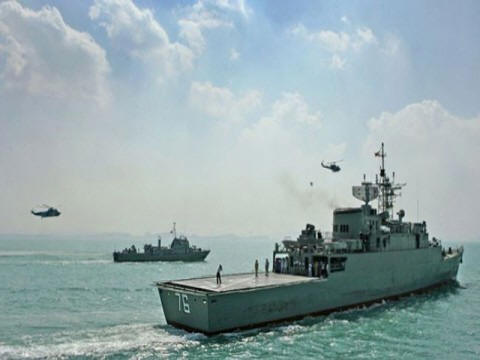
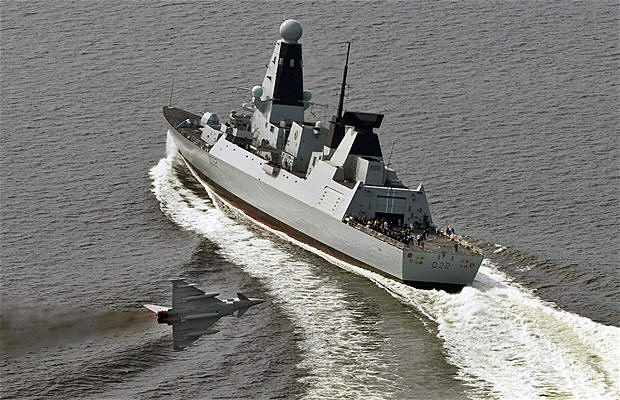
Naval commanders believe the
deployment of HMS Daring, a Type 45
destroyer, will send a significant
message to the Iranians because of
the firepower and world-beating
technology carried by the warship.
Philip Hammond, the Defence
Secretary, has publicly warned Iran
that any blockade of the Strait of
Hormuz would be "illegal and
unsuccessful". The Daily Telegraph
understands that HMS Daring has been
fitted with new technology that will
give it the ability to shoot down
any missile in Iran's armoury. The
£1 billion destroyer, which will
leave Portsmouth next Wednesday,
also carries the world's most
sophisticated naval radar, capable
of tracking multiple incoming
threats from missiles to fighter
jets. Daring, with its crew of 190,
will transit through the Suez Canal
and enter the Gulf later this month
to replace the Type 23 frigate
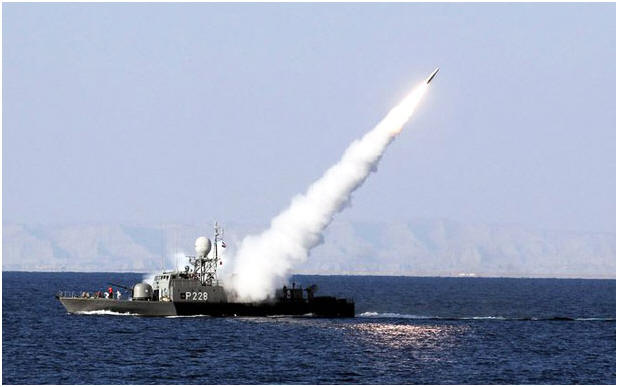
currently on station. Iran completed
a 10-day naval exercise in the
sensitive waters near the Strait of
Hormuz on Tuesday, staging
manouevres which included firing
three anti-ship missiles understood
to be the Chinese-made C-802.
Yesterday, Tehran said that another
exercise would be held in the same
area next month. Admiral Ali Fadavi,
commander of the naval branch of the
Revolutionary Guard, warned that
this would be different from the
most recent one. Speaking earlier,
Mr Hammond said that our joint
naval presence in the Arabian Gulf
was key to keeping the Strait of
Hormuz open for international
trade. A Navy source has indicated
that more British ships could be
sent to the Gulf if required. The
second Type 45, HMS Dauntless, will
also be available to sail at short
notice.
EDITORIAL - As the City of London leads
the battle against the euro it is
time to look more closely at Britain's
situation, which is far from glorious.
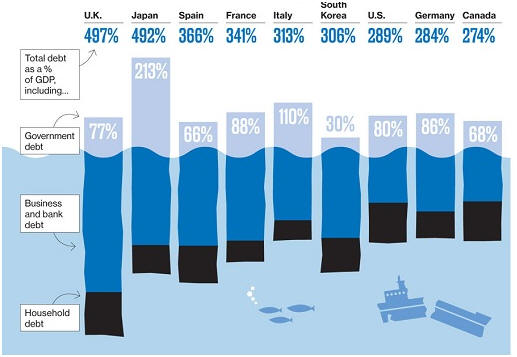
Britain tops the table as the nation
with the greatest combined debt
(government, corporate and household) to
GDP in the world. Its combined debt
dwarfs that of Italy's. If, as the City
wishes, the euro collapses, the British
government will have to do more than
just help Britons abroad survive a
European banking collapse. The British
banking system is highly exposed with
more business and banking debt than
Italy and France combined. With the
collapse of the euro Britain's
businesses and exports would founder in
the wake and British workers (all
salaried persons) would find themselves
caught in the turmoil as banks closed
their doors. The war waged against the
euro is one of mutual destruction and
victory would be worse than Pyrrhic.
NEW
YORK - OccupyWallStreet - Over the last 30 years, the 1% have
created a global economic system -
neoliberalism
- that attacks our human rights and destroys our
environment. Neoliberalism is worldwide - it is
the reason you no longer have a job, it is the
reason you cannot afford healthcare, education,
food, your mortgage. Neoliberalism is your
future stolen. Neoliberalism is everywhere,
gutting labour standards, living wages, social
contracts, and environmental protections. It is
"a great vampire squid
wrapped around the face of humanity,
relentlessly jamming its blood funnel into
anything that smells like money."
It is a system that ravages the global south and
creates global financial crisis - crisis in
Spain, in Greece, in the United States. It is a
system built on greed and thrives on
destabilizing shocks.
It allows the 1% to enrich themselves by
impoverishing humanity. This has to stop! We
must usher in an era of democratic and economic
justice. We must change, we must evolve. On
October 15th the world will rise up as one and
say, "We have had enough! We are a new
beginning, a global fight on on all fronts that
will usher in an era of shared prosperity,
respect, mutual aid, and dignity."
http://bankers.tk/
Its a
good question. John Francis Kinsella
attempts to answer it in his novel The
Turning Point published by
TheBookEdition. The novel is the first
part in a triology covering 2007-2008
and will be continued in 2009-2010. The
final part 2011-2012 is ongoing. The
Western world has reached a turning
point where its decline seems inevitable
unless leaders take decisive action to
end the rot.
Excerpt:
Launching his war on terror, Bush
galloped, accompanied by his faithful
sidekick, Tony Blair, to create a
different version of Bush the father’s
post-Soviet New World Order, where, in
Winston Churchill’s words: the
principles of justice and fair
play...protect the weak against the
strong — or was it the other way around?
The
widely hailed New World Order held a
number of unexpected surprises in store
for those who had acclaimed it. The
neo-liberals had won the battle, through
deregulation and by abandoning state
control and protectionism, allowing the
world to continue its path towards the
economic and political model preached by
Reagan and Thatcher. Market forces
replaced governments in determining
economic direction, whilst the world,
and more especially China, discovered
that liberalization could exist without
democratization. The consequence of
these changes tilted the balance of
economic power inexorably towards the
East.
Under
Bush and Blair interest rates were
slashed and a loose monetary policy was
pursued to compensate the loss of
business confidence and weak share
prices. This led to a global credit and
property boom, signalling the start of
an uncontrolled race for wealth by the
world’s investment bankers and financial
institutions.
Unwittingly the leaders of the rich
nations had started a count down to what
was, by its very scale, the greatest
financial crash in all history, the
consequences of which led to a
historical turning point, a momentous
loss in the relative wealth and economic
power of the nations that had ruled the
world for more than a century.
There
would be winners and losers. One of the
winners was China; the UK an also ran.
The former appeared poised to claim the
lion’s share of the global economy, and
the latter to finally admit the remains
of the predominant global influence it
had built over two centuries in industry
and finance were gone — forever.
As this
modern tragedy was played out, certain
actors congratulated themselves, perhaps
prematurely, for having avoided the
worse and even profited from the changes
that had been forced upon their world.
Max Hastings -
Times are tough. The British economy is
languishing. The Exchequer stands as
empty as Gordon Brown left it. Retailers
wring their hands.
Sir Mervyn King,
governor of the Bank of England,
declared in a speech last week that
Britain is in the midst of a biblical
seven lean years.
My worry, and that of
many cleverer and more important people,
is that seven years may not be the half
of it.
Britain is one of
many Western societies — including the
United States — facing grave structural
economic, educational and social
problems that threaten our prosperity
through future decades.
The economic chaos
that has overtaken Greece stems from the
follies of the euro. But it would be
rash to be complacent that such things
could never happen here.
I admire David
Cameron and support his Government’s
economic policies. But I have yet to
hear any minister credibly explain how
Britain will make its living through the
21st century with a workforce more
expensive, yet less skilled and
hard-working, than those of Asia.
Many of the West’s
current economic problems seem not mere
short-term fall-out from the 2008
banking crisis, but reflect deeper woes:
the historic transfer of wealth, and
perhaps also power, from West to East.
‘Complacency is baked
into our species,’ Nathan Myhrvold, the
American former chief technologist of
Microsoft, wrote this week.
‘Give us a run of
good luck and we are apt to turn that
into an implicit expectation that our
luck will continue — even that we are
entitled to it.’
Though Myhrvold was
not thinking of the British people, his
words apply to us in spades. Yet the
latest Merrill Lynch World Wealth report
shows that, while 300,000 new
Asia-Pacific investors with at least a
million dollars of investable assets
were created last year — a 9.7 per cent
increase — Britain’s percentage
increased by only 1.4 per cent.
This country exports
more to Ireland’s 4.5 million people
than to Brazil, India and China’s
combined 2.8 billion population — this,
despite a 20 per cent recent devaluation
of the pound.
I often disagree with
the brilliant but sensationalist
historian Niall Ferguson. But he seems
absolutely right to argue in his latest
book, Civilization: The West And The
Rest, that our societies have suffered a
disastrous decline of the Protestant
work ethic.
‘Europeans today,’ he
says, ‘are the idlers of the world.’
We work shorter hours
than our Asian counterparts, take more
holidays and are readier to strike.
Workers in the United States take fewer
holidays than us, but the average South
Korean puts in 39 per cent more hours
than the average American a week.
Neither President
Obama nor anybody else has yet produced
a credible solution to the problem that
Detroit’s car workers — for instance —
cost almost ten times as much as their
Chinese counterparts to produce the same
vehicles.
The young workforce
of Singapore is not only more energetic
than our own, but increasingly
better-educated. Education Secretary
Michael Gove is attempting a radical
transformation of British schools, but
faces bitter resistance from the
educational establishment, in stubborn
denial about our children’s ignorance.
I was almost lynched
by an unsympathetic audience on BBC’s
Question Time a few months ago, when I
asserted that many British university
degrees are not worth the paper they are
written on, and that many graduates
deserve only Firsts in clubbing.
But Niall Ferguson
cites a recent survey which exposes
students’ pathetic ignorance even of our
own history.
Only 34 per cent knew
that Queen Elizabeth ruled England at
the time of the 1588 Spanish Armada;
just 16 per cent identified Wellington
as British commander at Waterloo; a
pitiful one in ten could name any
19th-century prime minister — a gallery
that includes Pitt, Wellington,
Gladstone, Disraeli.
To assert that
today’s young know less than we did is
not merely to play the ageing bore, but
to state the obvious.
Another related and
disturbing trend in Western societies is
the widening chasm between the
successful minority, who prosper
mightily in the new world, and the
less-skilled, less successful majority,
whose living standards are progressing
nowhere much, and seem unlikely in
future to do so.
Chief executives,
financial engineers, entrepreneurs and
top professionals are amassing huge
earnings. Over the past 30 years, during
which the British economy has doubled in
size, the top 10 per cent of earners
have seen their incomes quadruple.
Meanwhile, low-income earners’ pay
increased by only 27 per cent between
1978 and 2008.
A new TUC report, The
Livelihood Crisis, claims that British
working households on £12,000-£30,000 a
year will be an average of £720 a year
worse off in real terms in 2012 than
2009, as rises in pay lag behind
inflation and state benefits are
reduced.
Even if this figure
is exaggerated, it is indisputable that
most people’s living standards are
flagging, while chief executives of FTSE
companies saw their incomes increase by
an average 32 per cent last year.
This pattern is even
more emphatic in the U.S., where an
unprecedented concentration of wealth is
emerging, while the mass of workers grow
no better-off.
Nobel Prize-winning
economist Michael Spence writes with
dismay of this gulf, ‘with
highly-educated workers enjoying more
opportunities and workers with less
education facing declining employment
prospects and stagnant incomes’.
The remedy of
Britain’s TUC is the familiar Socialist
one: it urges the Government to increase
subsidies for industries and jobs, and
provide a more generous cash safety-net
for those at the bottom of the pile.
Few people with
memories of the vast sums of taxpayers’
money squandered on supporting industry
between 1945 and our own times will
endorse such notions. We cannot push
water uphill, nor fence ourselves off
from overriding global trends and
pressures.
But there must be
political implications in the emergence
of a new Britain — and United States,
and much of Europe — in which maybe
10 per cent of clever and successful
people drink champagne, while many of
the remainder struggle amid a sea of
household debt and static real incomes.
We can be confident
the Government will see off the TUC’s
planned wave of strikes against slashed
public-sector pension entitlements.
Private-sector workers see the
unfairness of using their taxes to fund
absurdly generous state-worker
provisions such as they cannot afford
for themselves.
We may not see in
Britain Greek-style riots — caused by
popular resentment against falling
living standards — tomorrow or even the
day after. But what if, a decade or so
from now, most British people see
themselves getting poorer, while the
rich get ever richer? Will millions of
frustrated workers indefinitely
acquiesce in drastically lopsided
rewards?
The middle class are
not merely squeezed now, but seem likely
to stay that way. My favourite old Tory
grandee seeks to soothe my fears by
asserting that inheritances will assuage
middle-class pain. The lifestyle of many
families, he argues, will be preserved
by legacies when their home-owning
parents die.
This is true up to a
point, but prosperity can, in the end,
be sustained only through rising incomes
gained from real economic growth.
We have scarcely
begun to see the long-term consequences
of a world in which China is consuming
80 per cent of the world’s steel,
aluminium and copper, together with
70 per cent of Africa’s timber
production.
Beijing has gained an
armlock on the African continent, where
more than two million Chinese now work.
The British
Government is busy committing us to
ever-more draconian targets for cutting
carbon emissions. Oil prices are bound
to keep rising, with an estimated
increase in world demand from 86 billion
barrels a day in 2007 to 116 million in
2030. Rising energy costs, accelerated
by the Government’s green policies,
further diminish Britain’s industrial
competitiveness.
The magazine Business
Week remarked a year or two ago that the
three scariest words in American
industry’s lexicon are ‘the China
price’. This meant that a U.S. company
which cannot manufacture a given product
as cheaply as its Asian rivals is likely
doomed.
But unless Britain
raises its game dramatically, we face
not Mervyn King’s seven lean years, but
70 of them.
We must work harder,
teach our children more, and sell far
more goods which the world wants, not at
a price determined by the lifestyle
expectation of our workers, but instead
by global competition. No politician has
yet begun to tell the British people
just how harsh our choices are. Until
they do, I fear that we shall remain in
our usual favoured abode: dreamland.
TEN YEARS
OF FRUITLESS WARS - A DEVASTATING
VERDICT
Correlli
Barnett - As a military
historian who for half a century
has been writing about British world
policy, I am reduced to near despair
by David Cameron's positively
Blairite belief that to intervene
militarily in Libya was 'a moral
imperative'. What have 'moral
imperatives' got to do with
protecting the United Kingdom and
enhancing the wealth of the British
people?
It may be that
this belief is a symptom of
Cameron's head prefect-like
intellectual arrogance, or of his
Defence Secretary Liam Fox's
paranoid fears that Britain is beset
with foreign threats of every kind
which must be combated all over the
world.
But why have both
men so utterly failed to heed the
stark lessons taught by previous —
and still ongoing — Anglo-American
interventions in Afghanistan and
Iraq?
Back in 2001,
after Al Qaeda's attack on the Twin
Towers in New York, it all seemed so
simple to a technocrat like then
U.S. Defence Secretary Donald
Rumsfeld, and his strategically
naive President, George W. Bush.
You deployed your
bombers in a 'War on Terror' in
support of a bunch of Afghan
warlords (the so-called 'Northern
Alliance') to enable them to
overthrow the Taliban regime which
had given sanctuary to Al Qaeda's
leader Osama Bin Laden.
You then
installed a pro-Western government
under a clown of a president called
Hamid Karzai, and the job was done!
Except that, ten
years on, it isn't. Karzai's corrupt
and incompetent regime is only kept
going thanks to Western subsidies
and the military support of Nato
(overwhelmingly American and
British) occupation forces, while
the Taliban still carries out its
suicide bombings, and awaits its big
chance.
Now President
Obama and Prime Minister Cameron are
talking of pulling all combat forces
out from Afghanistan by 2014 — a
full 13 years after the original
'in-and-out' job Donald Rumsfeld
envisaged.
Pointedly, Obama
said in this week's speech that
there was not a single U.S. soldier
on the ground in Libya. In other
words, America is not taking part in
this adventure.
But Obama also
made it clear that his immediate
withdrawal of the 'surge' troops put
into Afghanistan and his decision to
pull out all troops within three
years is an end to the whole
American policy of 'liberal
intervention' abroad pursued under
Clinton and Bush.
This is a seismic
change. The U.S. is going to adopt
the kind of global strategy
specifically rejected in Britain by
Liam Fox — that of a fortress
America policy, where the U.S.
reduces global engagements and
concentrates on protecting its own
borders.
It would be utter
folly for Britain not to follow
suit.
To continue a
British world strategy without U.S.
support would mean bearing collosal
risks of becoming embroiled in
trouble spots around the world when
we have neither the resources nor
the stomach to do so.
The cost in blood
of the needless neo-imperialist
adventure in Afghanistan has been
heavy indeed. The UK has so far lost
more than 370 there, and still the
newly fallen are paraded in
flag-covered coffins through crowds
of mourners in Royal Wootton
Bassett.
To this total
must be added the 179 killed in Tony
Blair's invasion and occupation of
Iraq. The number of those grievously
wounded in the course of these two
political adventures (the MoD is
notoriously cagey about this figure)
probably comes to around 1,700, if
not more
These are the men
and women who have done the fighting
while Labour and Tory prime
ministers, foreign secretaries, and
defence ministers have, in Cameron's
egregious words, done the talking.
These are the
victims of a British world policy to
interfere in other nations.
How many schools
or hospitals could have been
constructed or re-equipped for such
a sum? How many state-subsidised
'affordable' houses could have been
built?
And what has been
achieved at such vast cost? In Iraq,
there is still no secure and stable
political settlement.
It has proved
impossible for squabbling
politicians to agree on a
government, while insurgents
continue with their suicide
bombings. The living-standards of
ordinary Iraqis have still not
recovered to the level enjoyed under
Saddam Hussein.
The cost in
treasure to the British taxpayer of
the interventions in Iraq and
Afghanistan stands at more than £20
billion
The cost in
treasure to the British taxpayer of
the interventions in Iraq and
Afghanistan stands at more than £20
billion
And never must we
forget the human cost to the Iraqi
people of Bush and Blair's adventure
— more than 100,000 dead, and more
than million refugees.
Since Saddam
posed no threat at all to the U.S.
or Britain, had nothing to do with
the destruction of the World Trade
Centre on September 11, 2001, and
was even an enemy to Al Qaeda, it
can be said for certain that Blair's
exercise of the 'moral imperative'
over Iraq served no British interest
whatsoever.
Far from making
Britain a safer place, our
occupations of Iraq and Afghanistan
have actually rendered Britain and
the world less secure.
It is now
admitted by Whitehall that the
spectacle of British troops and
their U.S. allies in their Darth
Vader costumes shouldering their way
through Muslim villages, or of
aircraft or drones bombing such
villages and killing their
inhabitants, has aroused the anger
of the Muslim communities in our own
cities.
This is
especially true of Muslim youth,
such as the perpetrators of the
'7/7' London bombings in 2005.
But it is not
just British Muslims who are
incensed. Terror attacks have
increased the world over.
The U.S. and its
allies invaded Afghanistan to
destroy Al Qaeda, but Al Qaeda has
spread with a vengeance to Yemen,
Somalia, and Pakistan.
Meanwhile, the
invasions have inflamed Palestinian
opinion and peace with Israel is
further away than ever.
Now Cameron and
Fox have led Britain into a new
adventure in Libya, another Muslim
country. Do they believe, like Tony
Blair, that they are being guided by
God?
Libya has so far
cost us £200 million in fuel, bombs,
and missiles. According to official
sources, this total may well run far
higher.
But what if
Gaddafi does not soon fall like a
ripe date from a palm-tree rudely
shaken? What if bombing doesn't
work?
Ever since World
War II, British and American
leaderships have believed that
airpower can win wars all by itself.
Yet in Vietnam in
the Sixties the U.S. lost the war,
despite having complete aerial
mastery.
In 1999,
President Clinton and Tony Blair
believed that two days of air and
missile strikes would compel
Milosevic to evacuate Kosovo. He was
not compelled.
The attacks had
to be widened to civilian targets
and continued for another two
months. But even then, neither
Serbian President Slobodan Milosevic
nor the Serbian people were cowed.
So the grim
prospect loomed of having to fight a
ground war against the formidable
Serbian army. From this peril, Nato
was rescued only by Russian
diplomatic intervention which
persuaded Milosevic to give way.
Today Cameron,
Fox, and presumably President
Sarkozy, in defiance (or ignorance)
of history are betting on airpower
as the magic bullet that will topple
Gaddafi. But what if airpower fails
yet again?
Where do we find
the troops and the logistic back-up
for a ground force large enough to
win a land campaign, even with the
aid of the untrained rabble of
rebels?
We have 10,000
service personnel stuck in
Afghanistan alone. But when the need
for rotation of units and for
training is taken into account, the
Afghan commitment is actually
swallowing some 40,000 men — a third
of the British Army.
No wonder senior
soldiers are warning that our armed
forces are too weak to support the
pretence of Cameron, Fox, and
Foreign Secretary William Hague that
Britain is strategically still a
first-class world power.
The truth is that
stronger armed forces would mean a
much bigger defence budget. How can
this be funded at a time of colossal
national indebtedness? Answer: it
cannot.
This means a
rock-hard decision must be made not
to become any further entangled in
Libya. And it means that we should
do exactly what Liam Fox warned us
this February not to do — choose 'a
fortress Britain policy' and follow
Obama's lead.
The U.S. is
actively stepping back from its
policy of global intervention. Its
voters are tired of the body bags
and the billions of dollars burned
up by its wars. What a tragedy that
all these lives and all that money
seem to have made the world only a
more perilous place than ever.
Exotic and less exotic royal
princesses more or less enjoying
themselves at work and play
while the rest of world gets on
with more serious things.
DAMASCUS - Syrian army
units opened fire on each other yesterday in
clashes over the crackdown on demonstrators. Al
Jazeera reported soldiers who refused to fire on
demonstrators were executed on the spot.
Thousands have fled to nearby Lebanon with an
estimated five hundred people killed since the
start of the revolt against Syria's dictator
Bashir Assad. In turn Marrakech was hit by a
suicide bomber in the heart of the tourist
district killing seventeen people, mostly
tourists. Those responsible are believed to be
al Qaida al Mahgreb.
Two
thousand illegal immigrants have arrived
from Libya in only 24 hours on a tiny
Italian island. A flotilla of rickety
boats docked at Lampedusa, which is
already struggling to cope with around
18,000 migrants who have fled the
political turmoil in the Middle East.
The island is usually home to 5,000
people. The latest arrivals are the
first from Libya since the crisis there
began. The boats were full of workers
from Eritrea and Somalia who were based
in the North African country. Raffaele
Lombardo, regional governor of Sicily,
which covers Lampedusa, described the
influx of illegal immigrants as a 'human
tsunami'.
BIG BROTHER IS WATCHING
YOU - Police are sifting through CCTV and surveillance
photographs to identify hard core protesters. As the
Disneyland royal wedding approaches fears grow that
anarchists and fellow travellers will disrupt the party.
Scotland Yard is working urgently to identify the
extremists who clashed with police before they can
strike again. The rally against the Government's
austerity programme brought chaos to Oxford Street and
Piccadilly, the capital's busiest shopping streets,
where they started fires, smashed their way into banks
and shops, including Fortnum and Mason, the department
store, and Topshop, and attacked the Ritz hotel. The
police declared these are criminal acts, every building
is being treated as a crime scene. Police demanded more
use of their powers to unmask protesters and stop and
search them for weapons, whilst saying the UK is not a
police state.
As Gaddafi threatened
retaliatory attacks on passenger aircraft in the
Mediterranean last night if foreign countries
launched air strikes against Libya. “Any foreign
military act” would expose “all air and maritime
traffic in the Mediterranean Sea” as targets for a
counter attack, Britain, the United States and
France were preparing to attack the regimes forces.
Gaddafi's threats were announced after America
formally backed a joint British and French
initiative for a no-fly zone over Libya and other
military action against Gaddafi’s regime. Amid
growing international concern at the deteriorating
situation in the country, the first bombing raids,
possibly by unmanned drones, could happen as early
as today. There were reports last night that the
first attacks would be unilateral actions by British
and French air forces with logistical support from
Arab states. The United Nations was meeting to
discuss the plan as Gaddafi’s troops massed on the
outskirts of Benghazi, the last stronghold of rebel
fighters.
CLOUD
DRIFTS TOWARDS USA AND CANADA
TOKYO — As
Japanese engineers fought to cool spent fuel
rods and restore electric power to pumps at the
stricken Fukushima Daiichi Nuclear Power Station
radioactive
cloud drifted towards USA and new challenges
seemed to accumulate by the hour, with steam
billowing from one reactor and damage at another
apparently making it difficult to lower
temperatures. The map published by
Le Monde in Paris, March 18, shows the
progression of the radioactive cloud towards the
North America. The level of radioactivity is
very low, well below danger levels, however if
the situation at Fukushima became critical
emissions would follow the same path. The red
area shows high concentrations of particles.
As the
crisis seemed to deepen,
Japan’s
nuclear safety agency raised the assessment of
its severity to 5 from 4 on a 7-level
international scale. Level 4 is for incidents
with local consequences while level 5 — the
rating used for crisis at Three Mile Island in
1979 — denotes broader consequences.
TRIPOLI - A major
oil port was ablaze in Libya today as clashes ripped
through the crippled country after Friday prayers. Thick
black smoke and flames engulfed the the key oil facility
at Zueitina, south of the Libyan rebel-held city of
Benghazi, after it was damaged in fighting. It is not
yet known if the damage was deliberate, but a policy of
torching 700 Kuwait oil wells was employed by Iraqi
dictator Saddam Hussein in 1991 which sent global fuel
prices soaring. The damage to one of Libya's prime oil
plants, which could produce as many as 500,000 barrels
of oil a day, came as forces loyal to Gaddafi fired tear
gas at protesters in Tripoli today. And it is understood
that at least 30 people were killed in violence in
Zawiyah, west of Tripoli. A witness said more than 30
people had been killed and 300 wounded there. Hassan
Warbok, identified by Al Jazeera as the rebel leader in
the city, was among the dead, it is understood. Amid the
violence, Interpol issued an alert for Gaddafi and 15 of
his family and associates intended to help impose
sanctions. The international police organization said
Friday that Gaddafi, his relatives and allies 'have been
identified as being involved in or complicit in planning
attacks, including aerial bombardments, on civilian
populations.'
LONDON - DAILY
TELEGRAPH As his country teeters on the brink, the
embattled dictator Colonel Gaddafi is clawing for
survival – both political and financial. Whether he
is toppled or not, Gaddafi is desperate to preserve his
fortune – some estimate it to be as much as £60 billion
– which has been squirrelled away in safe havens across
the globe. Yesterday, we learnt that the Treasury has
set up a specialised unit to trace Gaddafi’s assets in
Britain. So should we be surprised to learn that much of
his wealth has been salted away here? As we shall see,
the warm embrace of the Gaddafis into our society –
particularly Saif, the dictator’s second son – may have
offered financial gain, but it has also brought shame to
our shores. Only now can we see the damage done by those
who rehabilitated the Gaddafis on the international
stage. This was painfully revealed when Saif, a supposed
friend of the West, spoke on Libyan television this
week. Saif took the awkward manner of an international
plutocrat, forced only by circumstances out of his usual
exalted milieu of Blairs, Deripaskas, Mandelsons and
Rothschilds, to address Libya’s “little people”. The
“little people” are the protesters in Benghazi, an area
now largely freed from government forces. This region in
the east of the country has long been treated as
Tripoli’s poor relation – mainly because King Idris’s
regime was strong here before Gaddafi’s 1969 coup. How
demeaning it must have been for Saif to even talk to
such a poor, insignificant rabble. He and his sibling
Muatassim are so accustomed to the high life that they
have paid $1 million a pop to hear Mariah Carey, Beyoncé
and Usher sing at their birthday parties. Perhaps Mariah
sang Can’t Let Go or Can’t Take That Away From Me –
those lyrics of hers seem curiously apt today. It became
clear to me from his 45‑minute monologue that Saif,
friend of the Duke of York, was just another dictator in
a flashy suit. Whatever plutocrat’s polish he had
acquired along with his MSc and PhD at the London School
of Economics was rapidly shed. Jabbing his forefinger,
Saif warned that the besieged Gaddafis would “fight to
the last bullet”. Much of Libya’s wealth, generated by
crude oil and gas, has apparently been looted by Gaddafi
and his regime. His sons vie between them for such rich
pickings as the franchise to sell Coca‑Cola in Libya. As
well as Saif, the LSE seminarian and habitué of London
casinos and nightclubs, other Gaddafi brothers include
Hannibal, whose model wife Aline’s face has had several
nasty encounters with doors and furnishings in swanky
hotels in Geneva and London. Aline’s not the only one to
have come a cropper. When Hannibal was accused of
assaulting two maids in a Swiss hotel, and subsequently
arrested, Gaddafi retaliated by arresting Swiss
nationals in Libya (one poor chap found himself in
solitary confinement for more than 50 days) and even
suspended oil deliveries to Switzerland, as well as
withdrawing money and assets worth nearly £4 billion
from Swiss banks. Similar “heat” was applied to Blair’s
government over the release of Lockerbie bomber
Abdulbaset al-Megrahi, together with intercession by
former MI6 personalities such as Mark Allen, who had
moved on to well‑rewarded positions at BP. What’s clear
is that just as controversy and violence follows the
Gaddafi clan, so does the stench of filthy lucre. The
main vehicle for the Gaddafi’s wealth is the $70 billion
Libyan Investment Authority, a “sovereign wealth fund”
set up in 2006 to spend the country’s oil money. Let’s
call it Gaddafi Inc. In Britain, its assets include 3
per cent of the publishing giant Pearson, which owns the
Financial Times and Penguin Books; and several
prestigious office blocks, including 14 Cornhill,
opposite the Bank of England, and Portman House, home to
several major stores in Oxford Street. The LIA’s huge
investment in Britain happily coincided with the meeting
of minds between our leaders and the Libyans over the
release of the Lockerbie bomber. Likewise, British
investment in Libya has soared in recent years, with
some 150 of our companies – from BP to Next –
establishing a lucrative foothold there.
Extraordinarily, Saif told a British newspaper last year
that his “good friend” Tony Blair had become an adviser
to the LIA – an allegation the former PM denies. And
it’s not just business. The Gaddafis had ingratiated
themselves into the upper echelons of British society,
handily aided by Saif’s charm and the sage-like status
apparently conferred by his LSE doctorate. It is
reported that Saif was even hosted at Buckingham Palace
and Windsor Castle by the Duke of York. To go with this
highfalutin, upper-class lifestyle, Saif also purchased
a £10 million mansion in Hampstead – complete with
suede-lined cinema room and swimming pool. Land Registry
documents reveal that he used a British Virgin
Islands-registered company, Capitana Seas, to make the
purchase. So successful was his adoption of British ways
that he was lauded at the LSE by Professor David Held in
a speech. It described his former student as: “Someone
who looks to democracy, civil society and deep liberal
values for the core of his inspiration.” Now keen to
prove that it is not as amorally venal as many suspect,
the LSE has announced it will not take more of the £1.5
million pledged by Saif than the £300,000 it has already
spent on its weighty purposes. It is worth noting that
Mark Allen, who is credited with bringing Gaddafi senior
in from the cold, and Tony Blair’s former chief of staff
Jonathan Powell are present on the board of the LSE’s
IDEAS cost centre, while its director, Sir Howard
Davies, is a quondam adviser to the LIA. Tony Blair is a
highly paid consultant to J P Morgan, the US investment
bank that handles the LIA’s liquid funds. Small world,
isn’t it? Swinging London is but one hub of Gaddafi Inc
– a useful networking site where the Rothschilds were
able to point Saif Gaddafi to investment opportunities
in marina complexes in Montenegro. It’s known that Saif
had a desire to replicate a Dubai-style tax- and
visa-free enterprise zone north of Tripoli, as well as
developing luxury resorts near the spectacular Roman
ruins of coastal Libya. Funds for the latter emanate
from Magna Holdings, a Bermuda-based company chaired by
Charles Powell – yes, you guessed it, that’s the brother
of Jonathan Powell – and the firm responsible for
Gaddafi Tower, a 50‑storey development in Tripoli. Ties
between Libya and its former colonial master, Italy, are
also dense. A quarter of Libya’s oil and 15 per cent of
its natural gas goes to Italy, in the last case via the
Green Stream pipeline. Gaddafi Inc owns significant
shares in Italy’s ENI oil corporation, Fiat and
Finmeccanica, the Italian aerospace and defence
conglomerate. Its 7.5 per cent holdings in the football
team Juventus and the Unicredit bank are more
controversial, exercising the Northern League coalition
partners more than Prime Minister Berlusconi. This may
not be unrelated to the fact that both he and the
Libyans are heavily invested in a Paris-based film
company, Quinta Communications, which makes Arabic
language thrillers. Yes, as in Britain, the Italian
political class has not been fastidious in its Libyan
dealings. This may be why Italy’s response to the crisis
has been mixed, echoing Gaddafi’s warnings of a series
of al-Qaeda emirates, or of a tidal wave of African
migrants, if the Libyan lion ceases to roar at Europe’s
southern gates. And, as one would expect of the
self-styled “King of Kings”, Gaddafi Inc has major
investments in sub-Saharan Africa. The ex-footballer
Sa’adi Gaddafi, the third son of the dictator, took
charge of all the family’s investments in Robert
Mugabe’s Zimbabwe, where the Libyans were keen on
developing agriculture and tourism. Much Libyan money
has also been disbursed in Chad, Sudan, Sierra Leone and
Liberia. Various things may happen in Libya, where the
army lacks the unity and prestige of its Egyptian
analogue, and tribal allegiances are potent. As
generals, ministers, diplomats and brave fighter pilots
defect, the regime will be reduced to the hardcore of
Gaddafi and his sons. Threats to destabilise the flow of
oil to Europe are not as effective as they might be
since the Saudis, who hate Gaddafi’s guts, can increase
production. There are more local lessons for us in this
story. It was predictable that revolutionary Left
regimes – Castro, Chavez and Noriega – would defend
Gaddafi, even as his jets reportedly strafed “his” own
people. But Britain’s gossip columns and glossy
magazines also indulge a deracinated group of
international plutocrats whose greed is aroused by the
oil and gas revenues Gaddafi Inc has systematically
embezzled. Rather than mouthing empty platitudes about
orderly transition to democracy, in a country where
civil society has been suffocated by a police state, our
government should confiscate all the Gaddafis’ assets,
so as to return them to the Libyan people. After all, in
all its disgusting dealings with Libya, Britain knows
that money talks. London’s high society and academic
circles might be more fastidious too about consorting
with such a grotesque as this ghastly murderous man.
CAIRO - After violent protests throughout Egypt, state
media reported that the military had been ordered into
the streets to back up police struggling to contain one
of the most serious challenges to his long and
autocratic rule. A curfew was imposed, but fighting
continued on the streets of Cairo and smoke from fires
blanketed one of the city’s main streets along the Nile.
The ruling party’s building was in flames at nightfall,
and dramatic video footage on Al Jazeera showed a crowd
pushing what they identified as a burning police car off
a bridge. Al Jazeera said that Mr. Mubarak was expected
to deliver a televised address. As darkness began to
fall on Egypt, Al Jazeera reported a brief respite in
the violence as some police and protesters agreed to
hold their clashes to allow for evening prayers. But the
chaos continued afterward. US Secretary of State Hillary
Rodham Clinton said, 'We are deeply concerned about the
use of violence by Egyptian police and security forces
against protestors and we call on the Egyptian
government to do everything in its power to restrain the
security forces,' Clinton told reporters at the State
Department. 'At the same time, protesters should also
refrain from violence and express themselves
peacefully.'
UN NEW YORK
- Contrary to claims that the Himalayan glaciers
would disappear by 2035, researchers have
discovered that the ice flows in the Karakoram range
of the mountains are actually growing rather than
shrinking. This work challenges claims made in a
2007 report by the UN's Intergovernmental Panel on
Climate Change. However, Dr Rajendra Pachauri,
head of the Nobel
prize-winning UN Intergovernmental Panel on Climate
Change, maintained that global warming was
melting the glaciers at 'a rapid rate', threatening
floods throughout north India. The new study by
scientists at the Universities of California and
Potsdam has found that half of the glaciers in the
Karakoram range, in the north-western Himlaya, are
in fact advancing.
Dr Bodo Bookhagen, Dirk Scherler and
Manfred Strecker studied 286 glaciers between the
Hindu Kush on the Afghan-Pakistan border to Bhutan,
taking in six areas. Their report, published in the
journal Nature Geoscience, found the key factor
affecting their advance or retreat is the amount of
debris – rocks and mud – strewn on their surface,
not the general nature of climate change. Glaciers
surrounded by high mountains and covered with more
than two centimetres of debris are protected from
melting. Debris-covered glaciers are common in the
rugged central Himalaya, but they are almost absent
in subdued landscapes on the Tibetan Plateau, where
retreat rates are higher. In contrast, more than 50
per cent of observed glaciers in the Karakoram
region in the northwestern Himalaya are advancing or
stable.
VANDENBERG AIR
FORCE BASE CALIFORNIA - The largest rocket ever launched
from the U.S. West Coast successfully put its top
secret imagery satellite into orbit. The 235ft-tall
Delta IV Heavy Launch Vehicle lifted off at 1.10pm local
time yesterday with a classified U.S. government defence
satellite on board. Carrying cargo for the National
Reconnaissance Office, the booster rose into the sky
over California's central coast and arced over the
Pacific Ocean, a spectacle visible from 50 miles away.
This was the fifth launch of a Delta IV but the first
from the West Coast. The other four launches were at
Cape Canaveral, Florida.
Delta IV is
an active
expendable launch system
in the
Delta
rocket family. Delta IV uses
rockets
designed by
Boeing's
Integrated Defense Systems
division and built in
the
United Launch Alliance
acility in
Decatur, Alabama.
Final assembly is completed at the launch site by ULA.
The rockets are designed to launch payloads into orbit
for the United States Air Force
Evolved Expendable Launch Vehicle
program and commercial satellite business. Delta IV
rockets are available in five versions: Medium, Medium+
(4,2), Medium+ (5,2), Medium+ (5,4), and Heavy, which
are tailored to suit specific payload size and weight
ranges. Delta IV was primarily designed to satisfy the
needs of the U.S. military. This was the fifteenth
launch of Delta IV rocket.
WASHINGTON - As
Hu Jintao was feted in Washington, during a
state visit when President Obama pressed
China to open its markets to goods made by
American companies ,certain experts are
predicting a trouble on the horizon for the
Middle Kingdom's economy. Jim Chanos, a
well-known short-seller, predicted that China’s
property boom would end up like “Dubai times
1,000, or worse”. Easy credit and frenzied
investment were creating a huge bubble in the
prices of property and other assets. Bears also
believed that the high degree of state direction
in the Chinese economy was not an advantage, as
many admirers liked to imagine, but a chronic
weakness that fostered opacity, corruption and
the misallocation of capital. When the
pessimists dreamed of China they did not see
Pudong’s glittering skyline, but newly built
ghost cities hidden in the hinterland and
yuppies drowning in debt. China has not plunged
as Mr Chanos and a few fellow bears said it
would. But on this week Goldman Sachs, the Wall
Street trail blazer, issued a short-term alert
on China, as well as the other BRIC countries.
Tim Moe, the bank’s chief Asia-Pacific
strategist, told at conference in London: “To be
frank, we may have held on too long to our
overweight position in China last year. We have
decided that discretion is the better part of
valour and have tactically reduced our weight.
Asia is not in the sweet part of the cycle. The
longer-term picture of Asia outperforming the US
is taking a breather.” The bank is not as
bearish as the hedge funds - it thinks China
will rebound strongly in the second half of the
year. But the analysis, and the growing number
of bearish hedge funds, is making plenty of
traders look at China’s growth figures in a new
light.
LONDON - As Tunisians are
encouraged to demonstrate, school pupils and
a student in London have been arrested in connection with the
disorder that broke out during the university fees
protests last year. A 22-year-old female
student from Chiswick, west London, was arrested on
suspicion of violent disorder at the November
10 demonstration in central London. She was bailed pending further inquires,
Scotland Yard
said. A 16-year-old boy from Hornsey, north London, was
arrested yesterday on suspicion of committing the same
offence that day. A 17-year-old pupil from Upper
Holloway, north London, was arrested at his home
yesterday on suspicion of violent disorder and criminal
damage at another fees protest in the capital on
November 24. He was bailed pending further
inquiries. Two girls aged 16 and 17, both from Hanwell,
west London, were also arrested on suspicion
of criminal damage after they allegedly graffitied a
police van at the same demonstration. The protests saw
tens of thousands of students take to the streets,
joined by lecturers and parents, angered by government
proposals to hugely increase university tuition fees. But both
events brought violence and chaos to the capital as
angry young demonstrators clashed with police. Since
then more than 200 people have been arrested, most
in their late teens and early 20s. Last week,
Hampshire
student Edward Woollard was jailed for throwing a fire
extinguisher from the roof of the Millbank complex which
houses the Conservative Party headquarters. The
18-year-old was sentenced to 32 months behind bars for
his stupid act, but is a sentence of almost three years
prison justifiable when real violent criminals get off
with much lest, not to mind thieving politicians.
Identification was made at great cost by a large
specialized team working over a period of several weeks
using film taken during the demonstrations. Let us hope
this is heavy handedness and not the beginning of
Britain's Soviet style secret police?
TUNIS - The fallen
president's plane (above left) about to leave Carthage
International Airport carrying Zine El
Abidine Ben Ali and his family into exile. According
to different sources the plane was refused entry into
France and then Italy before heading to Saudi Arabia,
where in the past despots such as Idi Amin Dada had been
given refuge. After weeks of riots and an estimated one
hundred deaths the dictator was forced to quit Tunisia
after 23 years of undisputed power. The property of his
family and that of his wife's family was sacked and many
of his relatives arrested. In the night of Friday to
Saturday hypermarkets in Tunis were sacked and the
firing of automatic weapons heard across Tunis. Members
of Ben Ali's security forces were believed to had
participated in the looting. Thousands of holiday makers
were repatriated as riots spread to holiday resorts and
Tunisian airspace has been closed to traffic. For the
first time in the history of the modern world the people
led the revolt that toppled a dictator, demanding jobs
and freedom, and without the participation of religious
factions. The next days will decide the course of the
revolution as the prime minister of the dictator takes
temporary power. Oppression against the opposition
during Ben Ali's reign was such no charismatic leader
has appeared for the present.
...in the meantime Dublin braces itself for austerity
and London for swingeing cuts in social services
CHINA - Beijing
has leaked pictures of its new J-20 stealth
fighter a fifth generation combat jet designed
to fly long distances. China's neighbours and
the US are concerned by the Middle Kingdom's
ambitions in the China Sea and Pacific regions.
However, experts say that the design 'looks like
something that might have been designed in
1985'. In spite of this progress is being made
in giant steps thanks to reverse engineering.
Recently, Russia threatened to cut off supplies
of jet engines for China's JF-17, saying it had
been cloned from its Sukhoi 27/30 and MiG 29
aircraft – and was being sold for $10 million
less than the original. Considerable progress
has to be made in Chinese avionics, the
software-controlled electronic systems that
gives modern combat jets their cutting-edge
mission capabilities, which are believed to be a
generation behind their US, European, Israeli
and Russian counterparts.
The J20 is a
surprisingly large plane, considerably bigger
than the US F22 Raptor and heavier than the
Russian T50. Current consensus is that it’s
designed to carry more firepower and fly longer.
A
US Navy official described China as being years
away from being able to field the aircraft. 'In
terms of the stealth photos, the IOC (initial
operational capability) on the stealth aircraft,
it's still not clear to me when it's going to
become operational,' US Vice Admiral David
Dorsett, director of naval intelligence, said.
It is believed that the aircraft has not yet
made its maiden flight.
Man started
wearing clothes 170,000 years ago
enabling him to successfully migrate out
of Africa, according to a new study
following the evolution of lice. Dr
David Reed, a mammalogist at the
University of Florida, studies lice in
modern humans to better understand human
evolution and migration patterns. His
research shows modern humans started
wearing clothes about 70,000 years
before migrating into colder climates
and higher latitudes, which began about
100,000 years ago. Pinpointing this date
would have been virtually impossible to
determine using archaeological data
because early clothing would not survive
in archaeological sites. Instead, Dr
Reed's five-year study used DNA
sequencing to calculate when clothing
lice first began to diverge genetically
from human head lice. He said: 'We
wanted to find another method for
pinpointing when humans might have first
started wearing clothing. 'Because they
are so well adapted to clothing, we know
that body lice or clothing lice almost
certainly didn't exist until clothing
came about in humans.' The study also
shows humans started wearing clothes
well after they lost body hair, which
genetic skin-colouration research
pinpoints at about one million years
ago. Man therefore spent a considerable
amount of time without body hair and
without clothing, Dr Reed said. 'It's
interesting to think humans were able to
survive in Africa for hundreds of
thousands of years without clothing and
without body hair, and that it wasn't
until they had clothing that modern
humans were then moving out of Africa
into other parts of the world.' Unlike
other parasites, lice are stranded on
lineages of hosts over long periods of
evolutionary time. The relationship
allows scientists to learn about
evolutionary changes in the host based
on changes in the parasite. Applying
unique data sets from lice to human
evolution has only developed within the
last 20 years, and provides information
that could be used in medicine,
evolutionary biology, ecology or any
number of fields. Dr Reed said: 'It
gives the opportunity to study
host-switching and invading new hosts -
behaviours seen in emerging infectious
diseases that affect humans ' A study of
clothing lice in 2003 led by Mark
Stoneking, a geneticist at the Max
Planck Institute in Leipzig, Germany,
estimated humans first began wearing
clothes about 107,000 years ago.
LONDON
- Following a disastrous lead-up to
Christmas in Britain and most of
northern Europe with the coldest weather
recorded for 100 years in the UK many
questioned the veracity of the climate
change and global warming theory.
Airports, railways and roads became
unworkable as the Big Freeze struck.
Thousands of travellers returning home
for the Christmas break or leaving on
vacation found themselves stranded,
forced to sleep rough as authorities
were incapable of dealing with unusual
climatic conditions. Some experts blamed
the sun whilst others linked the weather
with man-made problems. Politicians
returning from Cancun sporting suntans
will undoubtedly have difficulty
explaining their expenses away to their
freezing constituents, worse the British
meteorological office will have
difficulty explaining its forty million
dollar supercomputer that predicted this
winter will be milder than in
previous years. In the meantime Shell
financed the multi-million climate
change exhibition at the Science Museum
opened at the beginning of the month by
Prince 'off with his head' Charles (see
below), who has campaigned to raise
awareness of global warming and its
effects. That brought little
satisfaction to millions trapped in a
'third world' travel nightmare as the
crisis gripping Britain's rail and air
network froze up and London
Heathrow invited stranded passengers to
use the toilets in the airport's
freezing car parks.
DUBLIN
- Following the vote by Irish lawmakers
on Wednesday to back the $90 billion
international rescue for Ireland, an
emergency measure designed to keep
Europe's debt crisis from getting worse,
this interview with an eminent Irish
commentator was recorded.
Prime
Minister Brian Cowen argued that
Ireland had no choice but to take
loans from the European Union and
International Monetary Fund at
interest rates averaging 5.8 percent
because bond investors were
demanding "far, far higher rates."
Ireland faces a 2010 deficit of 32
percent of gross domestic product, a
post-war European record that
includes exceptional costs of
bailing out five Dublin banks. The
Irish government plans to plough the
first $13.3 billion from the fund
straight into the cash reserves of
those banks, all of which have been
nationalized or partly acquired by
the state since 2008. Meanwhile,
ratings agency Moody's on Wednesday
warned it may downgrade Spain's debt
because the government is vulnerable
to a borrowing crunch next year,
when the recapitalization of weak
banks could prove more costly than
expected for public finances.
Moody's, which lowered Spain's
rating from Aaa to Aa1 in September,
says it will review the rating again
but does not expect the country to
need a bailout. The minister for
finance Brian Lenihan said it
mystified him that anybody in the
Dáil could oppose the measure.
LONDON -
Camilla sporting an emerald
necklace worth millions looked
shaken as she and Prince
Charles ran a gauntlet of fear
when their Roller became a
target for the wild mob, who
chanted "Tory scum" and "Off
with their heads". Students
rioted in protest against the
tripling of university fees from
£3,000 to £9,000 putting the 'future' of Britain in jeopardy
as the 'past' had an evening out
at the Royal Variety
Performance. The 'attack' came
in the form of rubbish, traffic
cones, bottles and plastic
barriers from roadworks, as the
royal Roller drove past the
demonstrators. It appears
that armed officers showed
'enormous restraint' by not
using their weapons against
the student who threw paint
on Charles' limo. The question is
would the police have shot protesting
students who now have to pay for
the errors of bankers and
politicians? Is this Britain's
Orwellian future? After the OECD
report on education this is not
an idle question. Send your
comments to sumpinein@gmail.com
SHARM EL-SHEIKH, EGYPT -
Terror stalks the popular Red
Sea resort visited by three
million tourists each year. Five
horrifying attacks have been
made by sharks in the last week.
Last Tuesday sunbathers watched
horrified as a Russian man
emerged on to the beach, blood
streaming from leg wounds.
Moments later, the predator
struck again, maiming another
Russian man who had to be
rescued by divers. This victim
had lost a foot and one of his
hands was dangling by sinews. A
Russian woman was the third
victim. On Wednesday came a
fourth attack, a Ukrainian man
with leg wounds believed to have
been caused by a shark. Egyptian
officials closed Sharm
el-Sheikh's beaches and ordered
a shark hunt. Two sharks, a
whitetip and a mako,
were captured and identified as
the culprits. But a local
conservation group – echoing the
plot of Jaws – smelled a
rat. They noticed that photos
taken by a diver of the shark
responsible for the second
attack proved it had not been
caught. Yet the anomaly went
unheeded by the Egyptian
authorities. Once again
mirroring the plot of the
Spielberg movie, they ruled that
the fear of further bad
publicity outweighed the risks
and the beaches were reopened,
only to close again yesterday.
As the hunt resumed last night,
the mystery of the shark's
extreme behaviour was deepening
as a German woman of 70 was
severely mauled as she swam
close to the shore in Sharm
el-Sheikh, losing a leg and her
right arm in an attack.
WASHINGTON — A
treasure trove of a
quarter-million
confidential American
diplomatic cables,
from the past three
years, provides a
brutally candid and
comical views of the
world's leaders. The
leaking of top secret
classified cables from
America's embassies has
catapulted the United
States into a diplomatic
crisis that experts
believe could
destabilise relations
around the world. But
what the leak has also
revealed is the
astonishing way in which
the United States
describes other world
leaders. Among them are
controversial Italian
Prime Minister Silvio
Berlusconi, whose 'close
relationship' with
Russian counterpart
Vladimir Putin is among
WikiLeaks documents
released.
MARKETWATCH.COM WSJ - NEW YORK Mean
Street: The Truth About Europe's
Bailouts. Mean Street columnist Evan
Newmark explains to WSJ's Dennis Berman
why he feels the solution to Europe's
economic crisis lies in sustaining unity
and changing from a welfare state
society to one that can compete in a
global economy. After the hysterics in
the financial media, commencing with
Bloomberg and CNBC it is time to
consider the in depth significance of
this particular facet of the on going
crisis. Mean Street's discussion gives
one point of view. However, the real
issue is a choice of society. Mean
Street talks of competition with China,
is that a reference, a slave society
governed under a Communist monopolistic
system? A one child family, a two speed
state with 700,000,000 desperately poor
peasants. Europe proposes a Union where
each integral state governs itself,
where the welfare of all its citizens
count, where people towards the end of
their lives can look forward to a secure
retirement, where the poor are cared
for, where the sick are cared for. To
paraphrase Winston Churchill's words,
'It
has been said that this is the worst
form of government except all the others
that have been tried.' Of course
this is not good news for those who
would like to see a society governed
from Wall Street, where only profits and
competitivity count.
On the
subject of competitivity, for memory the
economy of the European Union generates
a GDP of over €11,805.66 billion
according to the IMF, making it the
world's largest economy. The EU economy
consists of a single market and is
represented as a unified entity in the
WTO.
DUBLIN
- After Taoiseach Brian Cowen was forced
to apologize live on TV in September
for his performance in an RTE radio
interview which led to claims he was
"halfway between drunk and hung-over",
he now has a real headache. After the
ECB and IMF bailout he has to put
together a 4 year austerity programme
before elections in January 2011. If
implemented, it will mean that overall
spending on welfare will be cut by
almost 15 per cent. However, the
front-loading for the first year of the
plan, 2011, will be more modest than in
other sectors with an anticipated €800
million in cuts scheduled for
announcement in this year’s budget. The
160-page plan, setting out €15 billion
of savings over the next four years,
will be published at 2pm. The document
was sent to the printers yesterday
afternoon, as some late amendments –
mainly to do with economic data – had to
be included. The plan is broken into
five sections: current spending; capital
spending; taxes; potential areas for
economic growth; as well as a chapter on
reform. In the meantime Ireland's
short-term and long-term credit ratings
have been downgraded by the ratings
agency Standard & Poor in response to
the greater than expected cost of
recapitalising the banks. In a statement
issued this morning, the agency cut
Ireland's long-term sovereign rating to
'A' from 'AA-' while the short-term
grade was lowered to 'A-1' from A-1+.
Standard & Poor’s said Ireland's rating
may be lowered again if negotiations
over the International Monetary
Fund-European Union program or the
December budget fail to ease a funding
crunch. The agency said it has also
viewing short- and long-term ratings
negatively, meaning a further downgrade
is possible. The downgrade to 'A' and
the CreditWatch action applies to other
ratings that depend on Ireland's
sovereign credit rating, including the
issuer credit rating on the National
Asset Management Agency (Nama), and the
senior unsecured debt ratings on
government-guaranteed securities of
Irish banks. After Ireland Public sector
workers in Portugal have started a
nationwide strike that is expected to
cause the biggest disruption in more
than 20 years. The day-long walkout aims
to shut down most public services as
trade unions fight the government’s
austerity measures. Portugal is under
severe pressure to cut a high level of
national debt which is undermining its
economy and fuelling market concerns
that it may need a financial rescue.
Washington - A
state-owned Chinese telecommunications firm
re-routed around 15 per cent of all web traffic
through its own servers during a brief period on
April 8. The traffic included email exchanges from
websites of the US Senate and the Department of
Defence, along with NASA and the Department of
Commerce. Evidence related to this incident does not
clearly indicate whether it was perpetrated
intentionally and, if so, to what ends. Larry
Wortzel, a member of US-China Economic and Security
Review Commission, said : 'We don't know what was
done with the data when they got it. When I see
things like this happen, I ask, who might be
interested with all the communications traffic from
the entire Department of Defence and Federal
Government?' While sensitive data such as emails are
generally encrypted before being transmitted, the
Chinese government holds a copy of an encryption
master key which could be used it to break into
redirected traffic. With the massive scale and the
extensive intelligence and reconnaissance components
of recent high profile, China-based computer
exploitations suggest that there continues to be
some level of state support for these activities.
McAfee, the web security firm, has warned of a rise
in political cyber attacks, pointing to China as one
of the major actors launching assaults on foreign
networks including the White House, Department of
Homeland Security, US Secret Service and Department
of Defence, McAfee said in a report last year.
IRELAND - BAILOUTS, BEGGING BOWLS & THE EUROPEAN CENTRAL
BANK
DUBLIN - The
Irish Government has drawn up a last-ditch plan
to avoid being forced to accept a bank bailout.
It wants to borrow money for the banks supported
by a guarantee from the European Central Bank.
That would mean technically avoiding a bailout
and the politically damaging perception of a
loss of sovereignty. However, it would also risk
alienating EU leaders who are convinced that the
Government should take the bailout and get on
with restoring the public finances. And
regardless of what sort of 'bailout' eventually
emerges the Government will have to enforce a
draconian Budget next month. The revelation
comes as a high-powered delegation from the
European Commission, the European Central Bank
and the International Monetary Fund arrives in
Dublin today to begin negotiations on a deal to
restore confidence in the economy. Mergers,
nationalisation and the forced sale of banks
will all be on the table when European officials
debate a potential EU bailout. And shareholders
in Irish banks could have their values wiped
out. Finance Minister Brian Lenihan is also
coming under fresh pressure to raise Ireland's
corporation tax rate, which is vital to securing
more than 100,000 jobs. Luckless shareholders in
Irish banks could end up being wiped out in the
rescue plan put together by Brussels. The EU and
IMF have €750bn in reserve for ailing
sovereigns, made up of €60bn backed by the
bloc's budget, €440bn in euro zone guarantees
and €250bn from the Washington-based fund.
MEANWHILE PARIS HAS FUN &
THE
FED PRINTS
$600,000,000,000
CLIMATE CHANGE
FRAUD SENSATION
Isaac Newton: "Fie on you, Hansen,
Mann, Jones et al! You are not worthy of
the name scientists! May the pox consume
your shrivelled peterkins!"
SANTA BARBARA
- Harold Lewis is Emeritus Professor of Physics
at the University of California, Santa Barbara.
Here is his letter of resignation to Curtis G. Callan Jr, Princeton University, President of
the American Physical Society.
Anthony Watts
describes it thus:
This is an
important moment in science history. I would
describe it as a letter on the scale of
Martin Luther,
nailing his 95 theses
to the Wittenburg church door.
It is worthy of repeating this letter in
entirety on every blog that discusses
science.
It’s so utterly damning
that I’m going to run it in full without further
comment. (H/T
GWPF,
Richard Brearley).
Dear Curt:
When I first joined the American Physical
Society sixty-seven years ago it was much
smaller, much gentler, and as yet
uncorrupted by the money flood (a threat
against which Dwight Eisenhower warned a
half-century ago). Indeed, the choice of
physics as a profession was then a guarantor
of a life of poverty and abstinence—it was
World War II that changed all that. The
prospect of worldly gain drove few
physicists. As recently as thirty-five years
ago, when I chaired the first APS study of a
contentious social/scientific issue, The
Reactor Safety Study, though there were
zealots aplenty on the outside there was no
hint of inordinate pressure on us as
physicists. We were therefore able to
produce what I believe was and is an honest
appraisal of the situation at that time. We
were further enabled by the presence of an
oversight committee consisting of Pief
Panofsky, Vicki Weisskopf, and Hans Bethe,
all towering physicists beyond reproach. I
was proud of what we did in a charged
atmosphere. In the end the oversight
committee, in its report to the APS
President, noted the complete independence
in which we did the job, and predicted that
the report would be attacked from both
sides. What greater tribute could there be?
How different it is
now. The giants no longer walk the earth,
and the money flood has become the raison
d’être of much physics research, the vital
sustenance of much more, and it provides the
support for untold numbers of professional
jobs. For reasons that will soon become
clear my former pride at being an APS Fellow
all these years has been turned into shame,
and I am forced, with no pleasure at all, to
offer you my resignation from the Society.
It is of course,
the global warming scam, with the
(literally) trillions of dollars driving it,
that has corrupted so many scientists, and
has carried APS before it like a rogue wave.
It is the greatest and most successful
pseudoscientific fraud I have seen in my
long life as a physicist. Anyone who has the
faintest doubt that this is so should force
himself to read the ClimateGate documents,
which lay it bare. (Montford’s book
organizes the facts very well.) I don’t
believe that any real physicist, nay
scientist, can read that stuff without
revulsion. I would almost make that
revulsion a definition of the word
scientist.
So what has the APS,
as an organization, done in the face of this
challenge? It has accepted the corruption as
the norm, and gone along with it. For
example:
1. About a year ago
a few of us sent an e-mail on the subject to
a fraction of the membership. APS ignored
the issues, but the then President
immediately launched a hostile investigation
of where we got the e-mail addresses. In its
better days, APS used to encourage
discussion of important issues, and indeed
the Constitution cites that as its principal
purpose. No more. Everything that has been
done in the last year has been designed to
silence debate
2. The appallingly
tendentious APS statement on Climate Change
was apparently written in a hurry by a few
people over lunch, and is certainly not
representative of the talents of APS members
as I have long known them. So a few of us
petitioned the Council to reconsider it. One
of the outstanding marks of (in)distinction
in the Statement was the poison word
incontrovertible, which describes few items
in physics, certainly not this one. In
response APS appointed a secret committee
that never met, never troubled to speak to
any skeptics, yet endorsed the Statement in
its entirety. (They did admit that the tone
was a bit strong, but amazingly kept the
poison word incontrovertible to describe the
evidence, a position supported by no one.)
In the end, the Council kept the original
statement, word for word, but approved a far
longer “explanatory” screed, admitting that
there were uncertainties, but brushing them
aside to give blanket approval to the
original. The original Statement, which
still stands as the APS position, also
contains what I consider pompous and asinine
advice to all world governments, as if the
APS were master of the universe. It is not,
and I am embarrassed that our leaders seem
to think it is. This is not fun and games,
these are serious matters involving vast
fractions of our national substance, and the
reputation of the Society as a scientific
society is at stake.
3. In the interim
the ClimateGate scandal broke into the news,
and the machinations of the principal
alarmists were revealed to the world. It was
a fraud on a scale I have never seen, and I
lack the words to describe its enormity.
Effect on the APS position: none. None at
all. This is not science; other forces are
at work.
4. So a few of us
tried to bring science into the act (that
is, after all, the alleged and historic
purpose of APS), and collected the necessary
200+ signatures to bring to the Council a
proposal for a Topical Group on Climate
Science, thinking that open discussion of
the scientific issues, in the best tradition
of physics, would be beneficial to all, and
also a contribution to the nation. I might
note that it was not easy to collect the
signatures, since you denied us the use of
the APS membership list. We conformed in
every way with the requirements of the APS
Constitution, and described in great detail
what we had in mind—simply to bring the
subject into the open.<
5. To our
amazement, Constitution be damned, you
declined to accept our petition, but instead
used your own control of the mailing list to
run a poll on the members’ interest in a TG
on Climate and the Environment. You did ask
the members if they would sign a petition to
form a TG on your yet-to-be-defined subject,
but provided no petition, and got lots of
affirmative responses. (If you had asked
about sex you would have gotten more
expressions of interest.) There was of
course no such petition or proposal, and you
have now dropped the Environment part, so
the whole matter is moot. (Any lawyer will
tell you that you cannot collect signatures
on a vague petition, and then fill in
whatever you like.) The entire purpose of
this exercise was to avoid your
constitutional responsibility to take our
petition to the Council.
6. As of now you
have formed still another secret and stacked
committee to organize your own TG, simply
ignoring our lawful petition.
APS management has
gamed the problem from the beginning, to
suppress serious conversation about the
merits of the climate change claims. Do you
wonder that I have lost confidence in the
organization?
I do feel the need
to add one note, and this is conjecture,
since it is always risky to discuss other
people’s motives. This scheming at APS HQ is
so bizarre that there cannot be a simple
explanation for it. Some have held that the
physicists of today are not as smart as they
used to be, but I don’t think that is an
issue. I think it is the money, exactly what
Eisenhower warned about a half-century ago.
There are indeed trillions of dollars
involved, to say nothing of the fame and
glory (and frequent trips to exotic islands)
that go with being a member of the club.
Your own Physics Department (of which you
are chairman) would lose millions a year if
the global warming bubble burst. When Penn
State absolved Mike Mann of wrongdoing, and
the University of East Anglia did the same
for Phil Jones, they cannot have been
unaware of the financial penalty for doing
otherwise. As the old saying goes, you don’t
have to be a weatherman to know which way
the wind is blowing. Since I am no
philosopher, I’m not going to explore at
just which point enlightened self-interest
crosses the line into corruption, but a
careful reading of the ClimateGate releases
makes it clear that this is not an academic
question.
I want no part of
it, so please accept my resignation. APS no
longer represents me, but I hope we are
still friends.
Hal
Harold Lewis is
Emeritus Professor of Physics, University of
California, Santa Barbara, former Chairman;
Former member Defense Science Board, chmn of
Technology panel; Chairman DSB study on Nuclear
Winter; Former member Advisory Committee on
Reactor Safeguards; Former member, President’s
Nuclear Safety Oversight Committee; Chairman APS
study on Nuclear Reactor Safety
Chairman Risk Assessment Review Group;
Co-founder and former Chairman of JASON; Former
member USAF Scientific Advisory Board; Served in
US Navy in WW II; books: Technological Risk
(about, surprise, technological risk) and Why
Flip a Coin (about decision making). Telegraph.co.uk
THE
POLLUTION OF WAR
ISRAELI VICE
PREMIER - 'NO CHANCE OF PEACE IN NEAR FUTURE'
ISRAEL -
Vice Prime Minister and Strategic Affairs
Minister Moshe Ya'alon said Tuesday that he
saw "no chance of reaching a peace deal with the
Palestinians in the near future". "In the eyes
of Palestinians, the occupation began in '48 and
not in '67," Ya'alon told Army Radio. "Not only
Hamas thinks this – Abu Mazen [Palestinian
President Mahmoud Abbas] does too." "Their
refusal to recognize Israel as a Jewish state
shows they have no interest in having Israel as
a state beside theirs," he added. The remarks
made by Ya'alon, a former chief of staff of the
Israel Defense Forces, to Army Radio appear
contrary to Prime Minister Benjamin Netanyahu's
stated commitment on trying to reach an
agreement within a year. His comments also came
a day after the Palestinian Authority flatly
rejected Netanyahu's offer to suspend settlement
construction in exchange for a guaranteed
recognition of Israel as a Jewish state. The
Palestinians demand an entire freeze to
construction, and have said they will not resume
talks until such a guarantee is made. The U.S.,
which mediated the proxy peace negotiations and
played a key role in the short-lived direct
talks that followed, dodged a direct response to
the offer, saying its position on settlements
has not changed. "U.S. policy has been
consistent. Both President Obama and Secretary
Clinton are committed to Israel’s democracy as a
Jewish state," a State Department official said.
The direct negotiations were relaunched in
Washington early last month but came to a halt
on September 26, when Israel 10-month freeze
expired. http://www.hareetz.com
PALESTINIAN
AUTHORITY WILL NEVER RECOGNISE ISRAEL
The
Palestinian Authority will never recognize
Israel as a Jewish state, senior Palestinian
officials said on Tuesday, after Prime Minister
Benjamin Netanyahu proposed to freeze settlement
construction in exchange for that condition.
Palestinian negotiator Saeb Erekat said that
demand could never be accepted, while his
colleague Nabil Sha'ath added that the
government in Ramallah would not tolerate a
partial construction freeze and that the
moratorium must also be applied in East
Jerusalem. Senior Palestine Liberation
Organization official Yasser Abed Rabo accused
Netanyahu of using the proposal to weaken the
image of U.S. President Barack Obama in the
Middle East. Rabo also said Netanyahu was
begging to destroy the peace process and had
made the offer to distract from deliberations on
the core issues. The Palestinian leadership was
prompt to reject Netanyahu's proposal when he
offered it on Monday. Nabil Abu Rdainah,
spokesman for Palestinian President Mahmoud
Abbas, said a return to U.S.-backed peace talks
required a freeze on settlement building by
Israel . http://www.hareetz.com
US ALARMED BY
CHINA MILITARY
BEIJING — Defence
Secretary
Robert M. Gates
met his Chinese counterpart, Liang Guanglie, in
Vietnam on Monday for the first time since
the two militaries suspended talks with each
other last winter, calling for the two countries
to prevent “mistrust, miscalculations and
mistakes.” His message seemed directed mainly at
officers like Lt. Cmdr. Tony Cao of the Chinese
Navy. Days before Mr. Gates arrived in Asia,
Commander Cao was aboard a frigate in the Yellow
Sea, conducting
China’s
first war games with the Australian Navy,
exercises to which, he noted pointedly, the
Americans were not invited. Nor are they likely
to be, he told Australian journalists in
slightly bent English, until “the United States
stops selling the weapons to Taiwan and stopping
spying us with the air or the surface.” The
Pentagon is worried that its increasingly tense
relationship with the Chinese military owes
itself in part to the rising leaders of
Commander Cao’s generation, who, much more than
the country’s military elders, view the United
States as the enemy. Older Chinese officers
remember a time, before the Tiananmen Square
protests in 1989 set relations back, when
American and Chinese forces made common cause
against the Soviet Union. The stakes have
increased as China’s armed forces, once a fairly
ragtag group, have become more capable and have
taken on bigger tasks. The navy, the centrepiece
of China’s military expansion, has added dozens
of surface ships and submarines, and is widely
reported to be building its first aircraft
carrier. Last month’s Yellow Sea manoeuvres with
the Australian Navy are but the most recent in a
series of Chinese military excursions to places
as diverse as New Zealand, Britain and Spain.
ONE
MAN'S HOME IN MUMBAI
MUMBAI - The richest man in India,
Mukesh Ambani, does not appear to be
influenced by calls by the Indian prime
minister, Manmohan Singh, for business
leaders to be "role models of
moderation". Ambani, with his wife and
three children, has moved into his new
home in Mumbai which is 27 storeys high
and worth £630m. The building which is
named Antilia, after a mythical Island.
It contains a health club with a gym and
dance studio, at least one studio, a
ballroom, guestrooms and a range of
lounges and a 50 seater cinema. There is
even an elevated garden with ceiling
space to accommodate small trees. The
roof has three helicopter pads and there
is also underground parking for 160
cars. From the top floors of the 173m
high property are spectacular views of
Mumbai and of the Arabian Sea. In total
there is reported to be 37,000 square
metres of space, which is more than the
Palace of Versailles, and to keep it
running smoothly requires 600 staff.
According to Forbes magazine Ambani is
worth $25bn. He used to help run the
company before falling out with his
brother. The 53 year-old tycoon is not
only the richest man in India but the
fourth richest man in the world.
In a city where
about 6 million people live in slums,
where apartments that rent for $20,000 a
month can claim views of both the
Arabian Sea and homeless people
relieving themselves, where the rich
live among their poor servants. One
local newspaper columnist called it "an
edifice to his ego." Others have likened
Ambani to ostentatious and wasteful
Indian rulers of the past. But outside
the construction site, where a crane
hovers above the concrete and steel, and
workers ride elevators to reach the
upper levels, it seems that Ambani's
wealth is not resented but revered. "We
are proud of him," said Bhavanesh Asar,
a 30-year-old IT project manager. "He
has money. Why not? Bill Gates lives on
a 58-acre property for one family. [Ambani]
has funds, so why not?"
USAAF - ALIENS DEACTIVATED MISSILES
WASHINGTON,
September 27 - According to ex-USAAF pilots,
aliens from another planet have have landed on
Earth, infiltrated British and American
nuclear missile sites and sabotaged weapon. They
have been active since 1948, the officers said,
and accused governments of trying to keep the
information secret. The unlikely claims were
compiled by six former US airmen and another
member of the military who interviewed or
researched the evidence of 120 ex-military
personnel. The information they have collected
suggests that aliens could have landed on Earth
as recently as seven years ago. The aim is to
press the two governments to recognise the
long-standing extra-terrestrial visits as fact.
The aim is to press
the two governments to recognise the
long-standing extra-terrestrial visits
as fact.
THE
CATHOLIC CHURCH WELCOMES ALIENS
BIRMINGHAM
UK - Highly evolved extra terrestrial life forms
may be living in space and would be welcomed
into the church - "no matter how many
tentacles", one of the Pope's astronomers has
said. The senior
Vatican scientist, Brother Guy Consolmagno, said
that he would be delighted if we encountered
intelligent aliens and would be happy to baptise
them.
The questions
remains who would be the Conquistadores
and who would lead the Holy Inquisition?
Them or us? And who would baptise who?
Speaking during the Pope's visit to
the UK, and on the eve of addressing the
British Science Festival, Dr
Consolmangno said he had no problem with
science and religion co-existing
together. But he dismissed Creationism
and claimed that the revival of
"intelligent design" – the controversial
theory that only God can explain gaps in
the theory of evolution – was "bad
theology".
CHINA PREPARES FOR LUNAR LANDING
CHINA, Xichang,
Sichuan - A Long
March 3C rocket carrying the Chang'e-2 lunar
probe blasts off from the launch centre in
Xichang in the south-western Chinese province of
Sichuan. The probe will go into orbit within
15 kilometres of the moon.
It
is China's second unmanned lunar probe,
inaugurating the second phase of a three-step
moon mission, which will culminate in a
soft-landing on the moon. "Chang'e-2 lays
foundation for the soft-landing on the moon and
further exploration of outer space," said Wu
Weiren, chief designer of China's lunar orbiter
project. The lunar satellite is expected to take
about 112 hours, or almost five days, to arrive
at its lunar orbit, faster than the 12 days
taken by the Chang'e-1 three years ago. "It
travels faster and closer to the moon, and it
will capture clear pictures," Wu said.
Chang'e-2, named after a legendary Chinese
goddess of moon, will orbit 100 kilometres above
the moon, compared with 200 kilometres for
Chang'e-1. China launched its first lunar probe,
Chang'e-1, in October 2007, marking a milestone
in the country's space exploration. China became
the third country after Russia and the United
States to send a person into space in 2003. Two
more manned space missions followed with the
most recent in 2008 involving China's first
human space walk.
"During the 380,000-km journey to the moon, we
will conduct more orbit corrections if necessary
to ensure that it enters a lunar orbit," said Ma
Yongping, vice director of the flight control
centre.
The
satellite will eventually be manoeuvred into its
orbit just 15 kilometres above the moon.
Wu
Weiren said Chang'e-2 would take high-resolution
photos of the moon's Bay of Rainbows area, the
proposed landing ground for Chang'e-3.
...........READ
THE PRISM...........READ
THE PRISM..........
SPACE
CRAFT PASSES TEST
ASTEROID
MISSES EARTH
MINERS
RESCUED
UK FACES AUSTERITY
LONDON — Prime Minister
David Cameron
said that
Britain’s
financial situation was “even worse than
we thought” and that savage spending
cuts were needed to bring the deficit
under control. Stern and grim-faced Mr.
Cameron said, “The decisions we make
will affect every single person in our
country,” he said. “And the effects of
those decisions will stay with us for
years, perhaps decades, to come.”
MISUNDERSTANDING
BERLIN - Chancellor Merkel
was told, after a fractious EU summit on
Thursday night, that President Sarkozy
had publicly announced that Germany
would begin expelling 12,000 Roma next
month. Germany's foreign minister, used
diplomatic language, to describe the
issue as "misunderstanding" but
dismissed the suggestion as false.
"There was no such announcement by the
chancellor. It would run contrary to the
German constitution," he said.
CONSPIRACY IN PALACE
PARIS -
Rachida Dati plotted to oust Carla Bruni,
a book claims. Miss Dati, who fell out
of favour with the president, was
prepared to "stop at nothing to return
to such dizzy heights". She and her
fellow plotter hatched a plan more
fitting of the tradition of salon
scheming. Rachida Dati and Miss Douzal
believed Carla Bruni was a weak link in
the presidency. Their plan was to bring
back Cecilia to the Elysée.
N.KOREA'S MILITARY MIGHT
IN THE MOOD FOR
LOVE
CHINESE DRINK
OIL
FLOW SEALED
Gulf of
Mexico - The fight to cut off the flow of
oil feeding the giant oil slick in the Gulf of
Mexico could take three months, BP said today.
The oil giant launched a new front in its battle
to contain the spill, as engineers began
drilling a relief well designed to cut off the
leaking oil permanently. The new well, which is
in 5,000 feet of water, is planned to intercept
the existing well at 13,000 feet — about two
miles — below the seabed. It will be used to
inject cement to cap the one that is leaking.
Drilling began on Sunday at 3pm local time,
after days of delays caused by poor weather
conditions. However, BP confirmed that the
operation would take “some three months” to
complete.
ANGLO IRISH BANK
CHAIRMAN ARRESTED
Dublin - Irish police yesterday arrested Sean
FitzPatrick, the former chairman of Anglo Irish
Bank. Mr FitzPatrick,
a high-profile emblem of Ireland’s Celtic Tiger
boom years, is the first to have been arrested.
The Irish Independent predicted that Anglo’s
pre-tax loss for the 15 months to the end of
December could be as high as €12 billion — more
than Ireland collects in income tax annually.
The regulator has also been investigating
whether Anglo Irish used more than €7 billion of
short-term deposits from Irish Life & Permanent
to mask large customer deposit withdrawals.
VOTE FOR
EXTINCTION
Qatar -
Proposals to ban trade in bluefin tuna and
polar bears were overwhelmingly rejected
yesterday at the Convention on International
Trade in Endangered Species (Cites), meeting in
Doha, Qatar. Feelings were running high
yesterday about the failure of measures to
protect endangered tuna. Only 20 of the 120
countries at the meeting voted to ban trade in
the bluefin. Intensive lobbying by Japan, which
consumes 80 per cent of Atlantic and
Mediterranean bluefin, meant that a snap vote
was held before any debate on scientific reports
that show a catastrophic decline in the largest
of the tuna family.
ALICE IN
WONDERLAND
New York
Times Review - Tim Burton has done his best
work with contemporary stories, so it’s curious
if not curiouser that he’s turned his sights on
another 19th-century tale. Perhaps after
slitting all those throats in his adaptation of
“Sweeney Todd,”
he thought he would chop off a few heads.
Whatever his inspiration, he has tackled this
new story with his customary mix of torpor and
frenzy. After a short glance back at Alice’s
childhood and an equally brief look at her
present, he sends the 19-year-old on her way,
first down the hole and then into a dreamscape —
unfortunately tricked out with 3-D that
distracts more than it delights — where she
meets a grinning cat and a lugubrious
caterpillar, among other fantastical creatures.
Dark and sometimes grim, this isn’t your
great-grandmother’s Alice or that of Uncle Walt,
who was disappointed with the 1951 Disney
version of “Alice in Wonderland.” “Alice has no
character,” said a writer who worked on that
project. “She merely plays straight man to a
cast of screwball comics.” Of course the
character of Carroll’s original Alice is evident
in each outrageous creation she dreams up in
“Wonderland”
and in the sequel, “Through the Looking-Glass,”
which means that she’s a straight man to her own
imagination. (She is
Wonderland.) Here she mostly serves as a foil
for the top biller
Johnny Depp,
who (yes, yes) plays the Mad Hatter, and Mr.
Burton’s bright and leaden whimsies.
THE FINANCIAL
CRISIS NOVEL
International critics acclaim this novel of
the financial crisis, the story of Irish bankers
and City financiers in the worst financial
crisis since the crash of 1929. Contact our
literary critic at
sumpinein@gmail.com
PUU OO
ERUPTS
Stunning
video shots show the lava has reached just
behind the rim in one section, coinciding with
Volcano Awareness Month in Hawaii.
COMMENT
A sign of the
times. A modern folly or vision? The world's
tallest building built on petro-dollars and
speculation.
EDITORIAL
The leaders
of 192 countries met under the aegis of the
United Nations to come to an agreement to combat
climate change. Whether we are believers or not
this meeting has shown the incapacity of world
leaders to come to a meaningful agreement and
the futility of such conferences in the face of
individual nations own priorities. The USA and
China, the world's leading emitters of CO2,
whilst showing they are the two most powerful
nations on the planet, ignored the rest of the
world. At the same time China showed its true
face, arrogant and easily offended. What is
evident to every human being is that our world
is becoming more and more polluted with each
passing day and our leaders...and scientists are
incapable of finding a common ground to save us
from the fate we are preparing for future
generations.
SOME
AVOIDED BEING TAKEN TO THE CLEANERS
NEW BOOKS
EAT YOUR DOG!
Owners should consider doing
without, downsizing or even eating their pets to
help save the planet. A medium-sized
dog has the same impact as a Toyota Land Cruiser
driven 6,000 miles a year, while a cat is
equivalent to a Volkswagen Golf. But rabbits and
chickens are eco-friendly because they provide
meat for their owners while a canary or a
goldfish has little effect on the environment.
At the same time a pair of hamsters do the same
damage as running a plasma television, suggests
the book Time to Eat the Dog: The Real Guide to
Sustainable Living. New Zealand-based authors
Robert and Brenda Vale base their findings on
the amount of land needed to grow food for pets
ranging from budgerigars to cats and dogs. They
say an average Collie eats 164kg of meat and
95kg of cereals a year, giving it a high impact
on the planet. But a pair of rabbits can produce
36 young annually, which would provide 72kg of
meat and help decrease the owner's carbon
footprint.
AMADINEJAD
JEWISH?
A photograph of the
Iranian president holding up his identity card
during elections in March 2008 clearly shows his
family has Jewish roots. A close-up of the
document reveals he was previously known as
Sabourjian – a Jewish name meaning cloth weaver.
The short note scrawled on the card suggests his
family changed its name to Ahmadinejad when they
converted to embrace Islam after his birth. The
Sabourjians traditionally hail from Aradan, Mr
Ahmadinejad's birthplace, and the name derives
from the Jewish for "weaver of the Sabour", the
name for the Jewish Tallit shawl in Persia. The
name is even on the list of reserved names for
Iranian Jews compiled by Iran's Ministry of the
Interior. Experts last night suggested Mr
Ahmadinejad's track record for hate-filled
attacks on Jews could be an overcompensation to
hide his past. Ali Nourizadeh, of the Centre for
Arab and Iranian Studies, said: "This aspect of
Mr Ahmadinejad's background explains a lot about
him. "Every family that converts into a
different religion takes a new identity by
condemning their old faith. "By making
anti-Israeli statements he is trying to shed any
suspicions about his Jewish connections. He
feels vulnerable in a radical Shia society." A
London-based expert on Iranian Jewry said that "jian"
ending to the name specifically showed the
family had been practising Jews. "He has changed
his name for religious reasons, or at least his
parents had," said the Iranian-born Jew living
in London. "Sabourjian is well known Jewish name
in Iran." A spokesman for the Iranian embassy in
London said it would not be drawn on Mr
Ahmadinejad's background. "It's not something
we'd talk about," said Ron Gidor, a spokesman.
The Iranian leader has not denied his name was
changed when his family moved to Tehran in the
1950s. But he has never revealed what it was
change from or directly addressed the reason for
the switch.
PEACE HOPE
FADES
JERUSALEM - A
frantic effort by the US Middle East envoy
to wrest an agreement that would restart peace
talks appeared to have ended in failure
yesterday, inflicting President Obama’s first
important foreign policy setback. George
Mitchell shuttled between Jerusalem and the West
Bank attempting to wrest an agreement on
settlement building before the UN General
Assembly meeting next week. US officials had
hoped that Israeli and Palestinian leaders would
meet on the sidelines of the assembly,
kick-starting peace negotiations that have been
stalled for nearly nine months. But a
spokesperson for the State Department told
reporters, “There has been no agreement to have
the trilateral meeting . Of course we were
hoping for a breakthrough.” It appeared that
Israeli and Palestinian leaders remained at odds
over several key issues, most notably Israel’s
West Bank settlements. Mr Mitchell was said to
be pushing Binyamin Netanyahu, the Israeli Prime
Minister, for a year-long freeze but an Israeli
official said that this “was not an option”.
KIM JONG IL
DYING
North
Korea’s supreme leader, Kim Jong Il, is
suffering from cancer of the pancreas and is in
danger of dying of the disease, South Korean
television reported this morning, the latest and
most specific in a series of reports on the
dictator’s health. The information, which was
attributed by Yonhap Television News to
unidentified Chinese and South Korean
intelligence sources, is consistent with a
report in a Japanese newspaper over the weekend
that Mr Kim has a “serious pancreatic disorder”,
and with television images from North Korea last
week, in which he appeared haggard, emaciated
and slow on his feet.
BANKSY
EXHIBITION
Graffiti artist Banksy has pulled off an
audacious stunt amid tight secrecy to stage his
biggest ever exhibition. A burned-out
ice-cream van is among 100 works Banksy has
installed at Bristol's museum, replacing many of
the museum's regular artefacts. The reason the
museum was closed was kept secret from top
council officials. Banksy said: "This is the
first show I've ever done where taxpayers' money
is being used to hang my pictures up rather than
scrape them off." Staged in the council-owned
City Museum and Art Gallery, Banksy v Bristol
Museum features animatronics, installations and
a sensory display. "This show is my vision of
the future, to which many people will say: 'You
should have gone to Specsavers'", Banksy added.
The exhibition and its location have been a
closely-guarded secret since October, with just
a couple of museum officials in the loop. "I
think we may have dragged them down to our level
rather than being elevated to theirs," said
Banksy of the subterfuge involved in staging the
show in his home city. The artist himself was
involved in setting up the exhibits and came to
the museum to oversee its installation, but
staff were unaware who he was among the crew
setting up the show. He became famous after a
series of "guerrilla" stunts which saw him paint
the West Bank barrier and put an inflatable
figure of a Guantanamo Bay prisoner at Disney
World.
GORILLA WARFARE
Officially, monkeys,
apes and protected species shouldn’t be sold in
the Republic of Congo. Since years of civil war
finally ended in 2003, the government has been
trying to work with conservation organisations
and NGOs to try to lure tourists in to their
three National Parks and scattering of reserves,
and so has tried to ban the sale of endangered
bush meat. But it isn’t an easy task.
Congo-Brazzaville might be the fourth biggest
producer of oil in Africa, but corruption is
endemic, leaving its population of three million
poor and its infrastructure crumbling. Roads
sport potholes the size – and sometimes the
depth – of pool tables. There are few jobs. The
west of the country is overrun with opposition
militia called Ninjas, who have almost brought
the railway, and so trade, through the western
port of Pointe-Noire, to a halt. Even
electricity is in short supply; when we sit
having dinner in Brazzaville, the lights go out
several times – apparently because the only
supply now comes from the country’s even more
troubled neighbour, the Democratic Republic of
Congo. Besides, for centuries the people of
Africa have eaten bush meat: the flesh of wild
creatures who have fed on rich natural forests
which, I’m assured, is delicious. To tell
Congolese they can’t hunt, or have to buy (with
money many don’t have) thin chickens and
tasteless pork when there are delicious forest
creatures to eat is extremely difficult. Which
is why, in the stalls of Brazzaville’s main
market, there are few creatures that I can’t
buy. On a small scrubbed table, a three-foot
live crocodile lies miserably, its legs and long
nose tied with raffia to prevent it moving.
Turtles keep trying to flip themselves (to the
stallholder’s annoyance) from their shell onto
their feet. Butchers’ blocks are neatly piled
with cubes of smoked eland, wild boar, and whole
monkey carcases. And in the traditional medicine
section – hanging with feathers, beads, leaves,
flowers, bundles of bark, the soles of
elephants’ feet, jars of eyes, mammal foetuses,
birds' heads and little vials of cobra venom – I
am offered the very thing I hoped not to find:
gorilla bones. Current estimates for gorilla
populations make for depressing reading. Of the
most populous species – the western lowland
gorilla – there are thought to be about 125,000
left in the world. But at the current rate of
extermination of about 60 per cent in the past
25 years, according to Amos Courage of The
Aspinall Foundation, which is working with the
Congolese government to protect the species. “We
will be lucky if we have half of that left by
2020. And even fewer mountain gorillas,” he
says. Last year, he says, four gorillas were
intercepted en route from Cameroon to a zoo in
Malaysia – which had paid $1,600,000 (£1million)
for the primates.
SRI LANKA
HUMANITARIAN CRISIS
Thousands of civilians are trapped as Asia’s
longest-running civil war neared its endgame
amid scenes of “unimaginable humanitarian
catastrophe”. Trapped in trenches, with little
food and water, up to 50,000 ethnic Tamils are
pinned in a tiny pocket of land between the
final advance of the Sri Lankan Army and the
Tamil Tiger rebels facing imminent defeat. A
government doctor in the area said hundreds of
wounded civilians, many of them dying from their
injuries, had crowded into a makeshift hospital
that he was forced to abandon two days ago
because of shelling. “They are dying without
proper treatment,” said Thurairajah Varatharajah.
“Dead bodies are all lying on the floor. We are
unable to bury or clear them. It is a very
pathetic situation.” He said: “We are in fear
not just for my life, but for all the civilians
and patients and staff. Here there is no food,
no water, nothing.” Thileepan Parthipan, a
spokesman for the Tigers, said: “People are
dying every minute. The situation is critical.”
The final push to end the Indian Ocean island’s
26-year civil war comes in defiance of repeated
appeals for a ceasefire from most
Western governments. About 7,000 civilians have
been killed since late January, according to the
United Nations, which has called for an
independent war crimes inquiry to examine the
behaviour of both sides. The International
Committee of the Red Cross, the only neutral
organisation working in the conflict area, said
its staff were “witnessing an unimaginable
humanitarian catastrophe”. The army said 10,000
desperate civilians fled the area yesterday.
They risked being shot by both sides, but in the
past few days have paddled across a lagoon on
rubber tyres, or waded through its chest high
waters to the relative safety of army lines.
CINEMA &
TV
TARANTINO
TAKES ON HITLER
To say it's
a revisionist view of the second world
war is understating it, but when
Quentin Tarantino
takes on Hitler and the Nazis, there is
never any real doubt about who is going
to win.Tarantino today unveiled
Inglourious
Basterds
at the
Cannes film
festival,
starring
Brad Pitt
as the leader of a troop of Nazi-killing
Jewish-American soldiers in occupied
France.Pitt admitted the film was
"definitely outrageous" and recalled
Tarantino's visit to his French home
last summer to pitch it. "All I know is
we talked about backstory and we talked
about movies into the wee hours. I got
up the next morning and I saw five empty
bottles of wine on the floor. Five. And
something that resembled smoking
apparatus, I don't know what that was.
"Apparently I had agreed to do the movie
and six weeks later I was in a uniform."
Tarantino said he had wanted to create a
character for Pitt for a long time.
"Artistically, me and Brad have been
sniffing around each other for a while.
"The longing looks across the room, the
little notes, 'I like you, do you like
me.' Pretty quickly into writing I
realised this is the one for Brad and
then I started getting nervous – 'shit,
if he doesn't do it, what the fuck am I
going to do?'" Tarantino wrote
Inglourious Basterds for 10 years on and
off and it was financed and filmed, by
normal movie standards, remarkably
quickly in order to be ready for this
year's festival. It is a kind of
spaghetti western-comedy-fairy tale
where the characters revel in
violence.Asked if it was fair to call it
a Jewish revenge fantasy, Tarantino
said: "That wouldn't be how I would
define it 100%. You could definitely say
that and it works completely in that
way. That wouldn't be the section in the
video store I would maybe put it in.
"People ask me, is it a fairy tale? Is
it Jewish wish-fulfilment fantasy? There
are aspects of that but to me, more than
anything else, it is that my characters
change the outcome of the war. Now that
didn't happen because my characters
didn't exist, but if they had existed
then the movie is plausible." The actor
Eli Roth, who plays a baseball
bat-swinging Basterd, was upfront about
how he felt. "Being Jewish, for me it's
like kosher porn. It's something that I
have fantasised about since I was a very
young child. It was like I performed a
sex scene when I beat that guy to
death."
BRANAGH AS WALLANDER
Ystad,
a Swedish town provides the setting for
Wallander,
a trilogy of 90-minute TV movies
beginning Sunday on PBS' "Masterpiece:
Mystery!" The bodies really pile up
around there, something of a statistical
anomaly when you consider that the
murder rate
in Sweden is a little more than one
homicide per 100,000 citizens per year
and the fact that Ystad has a population
of only about 17,000. It's Hellmouth on
the Baltic. Based on a series of novels
by
Henning Mankell
that have been translated into many
languages and sold many copies around
the world, "Wallander" stars
Kenneth Branagh
as the eponymous police detective, and
it's good to see him. Apart from his
Shakespeare adaptations, and even
including some of them, Branagh's career
choices have not always been
commensurate with his talent as an
actor. But if he's no longer a golden
boy, there's something about him as he
creeps up on 50 that's even more
appealing, and he makes a neat fit for
the gone-to-seed, world-weary Wallander,
who no longer knows why he does what he
does but works even harder at it to
avoid dealing with his inability to sort
out his own life. I recommend the
series, though Sunday's opening film,
"Sidetracked," does present a bit of a
stumbling block. It is stylized to a
fault, a riot of saturated color,
reflections, distortions, and arty
shallow focus that might work for the
length of a music video or
pharmaceuticals ad, but is distracting
and distancing across the course of a
feature film. There was possibly some
intent to contrast the darkness of the
stories with the beauty of the location
-- the first thing that happens here is
that a girl sets herself on fire in a
gorgeous field of yellow grain. Even the
police station is a magazine-ready haven
of lovely Scandinavian design. But there
is creating mood and there is showing
off, and "Sidetracked" is so visually
hyper that the players seem to be
overacting even when they're sitting and
staring into space -- and there is quite
a lot of that, as Wallander is rendered
speechless by the
unravelling of the
Swedish social order.
ANGELS AND DEMONS
ROME
(Reuters) - After exposing a Church
cover-up in "The Da Vinci Code,"
symbologist Robert Langdon returns to
the big screen as an unlikely
Vatican ally in the latest movie
adaptation of a novel by author Dan
Brown. "Angels & Demons," again starring
Tom Hanks as Langdon and directed by Ron
Howard, premieres in Rome Monday at a
theater a mile away from Vatican City.
In the film, Langdon is recruited by the
Vatican after the pope dies and four
cardinals who are favorites to succeed
him are kidnapped. Langdon races through
the "Eternal City" deciphering clues
linked to a centuries-old secret
society, the Illuminati. "He is not the
man the Vatican trusts -- he is the man
the Vatican needs," Howard said in
production notes for the movie. Ewan
McGregor plays the central role of the "Camerlengo,"
or chamberlain, who runs the Vatican
between the time of the pope's death and
the election of his successor. "He sees
himself as a man who will do whatever it
takes to save the Church from the
Illuminati and everything they
represent," McGregor said. Angels &
Demons has so far avoided the kind of
broadside the Vatican aimed at The Da
Vinci Code film in 2005 and 2006 and the
following year at "The Golden Compass"
starring Nicole Kidman and Daniel Craig.
"Dramatizing the issue involuntarily
gives publicity to Angels & Demons,"
said Archbishop Velasio De Paolis, in an
interview with Italy's La Stampa
newspaper. "Be careful not to play their
game." The Da Vinci Code upset the
Vatican and some Catholics because of
its storyline, in which Jesus married
Mary Magdalene and had children,
creating a royal bloodline that Church
officials kept secret for centuries.
Christians are taught that Jesus never
married, was crucified and rose from the
dead. Despite the controversy, and a
critical mauling at the Cannes film
festival where it was launched, The Da
Vinci Code went on to gross more than
$750 million worldwide, supporting the
theory that no publicity is bad
publicity.
TERMINATOR SALVATION
Terminator Salvation: The Future
Begins (2009)
Starring: Christian Bale, Sam
Worthington, Anton Yelchin, Moon
Bloodgood, Common Director: McG U.S. Opening Date: May
22nd, 2009
Terminator Salvation: The Future
Begins will reinvent the cyborg saga
with a storyline to be told over a
three-movie span. The film is set in the
future, in a full-scale war between
Skynet and humankind. On January 6th
2008, producer John Middleton had the
following to say about the movie: "It's
post-apocalyptic. It's set after the
events of [Terminator 3: Rise Of The
Machines], where we see the nuclear
exchange at the end of the movie, and we
show what the world is like after this
event, and we show how people try to
deal in a post-apocalyptic world. And we
introduce a new character, who becomes
very important to the resistance and to
John Connor, a new hero. It's really
about the birth of a new hero." About
John Conner, he said: "I would look at
him as a character that is introduced
and that will grow in the second and
third movies of the trilogy." On Arnold
Schwarzenegger's involvement in the
film: "He has been approached, and in
the early days of our development of
T4, one of our producers, Andy Vajna,
who's a good friend of his, spoke to him
about doing a cameo. This was even
before he was governor. But we know now
that he is governor, he's got priorities
that are above doing movies."
Subscribe to the
Independent New York Times
(it's free)
STAR TREK RETURNS
THE TIMES -
The salute “live long and prosper” is
the Vulcan equivalent of “shalom”,
accompanied by a raised palm parted into
a “V” between the second and third
fingers. It neatly sums up the
flourishing and seemingly never-ending
story of Star Trek, whose
original brief — literally, its mission
statement — was to boldly go where no
man had gone before, and, 726 episodes
of five overlapping, live-action TV
series, one animated series, 11 feature
films and innumerable novels later, is
still doing just that. The $150 million
new movie — the very definition of what
Hollywood calls a “tent pole picture”
(that is, it is expected to carry the
weight of commercial expectation for an
entire media conglomerate) — docks in at
your local multiplex next week. Its
young cast, including our own Simon Pegg,
are hailed as superstars. Blog and
broadsheet alike have been falling over
themselves to be the first with a rave
review since it was first shown. Famous
fans such as Jonathan Ross, Quentin
Tarantino and even the leader of the
free world himself line up to express
their Starfleet-like
allegiance. But
hang on. This is Star Trek,
right? The tinpot space opera from,
like, the Sixties, with the bad actors
and the wobbly sets and the portentous
ideas above its station? The one that
was cancelled by its own network after
three seasons in 1969 and relaunched as
a movie franchise ten years later only
by applying some sturdy corsets to its
ageing cast and capitalising on the
success of the much more exciting
Star Wars? The Star Trek
beloved only of sexless academics and
sad white suburban males with few social
skills and poor hygiene, tramping off to
endless conventions dressed as Klingons
and Romulans? Well, yes. It’s a
phenomenon, Jim, but not as we know it.
By doggedly sticking to its guns over an
astonishing 43 years — or rather,
sticking to its peacenik “phasers”,
which can be set to “stun” as well as
“vaporise” — the starship USS
Enterprise has become politically
relevant again. Its once-radically
multiracial, multispecies crew and its
“prime directive” to explore rather than
conquer “strange new worlds” chimed with
the optimism of the space-race era and
now chimes again, thanks to the election
of Barack Obama, who showed his colours
at an election rally in Wyoming, saying,
“I grew up on Star Trek. I
believe in the final frontier.” Star
Trek steadfastly refuses to reach
that final frontier. But why? What makes
a show about some men and women in space
so enduring? Is it simple escapism, or
something deeper and more profound that
manages to make first contact with each
successive generation?
GODDESS & GENIUS
The Genius and the Goddess:
Arthur Miller and Marilyn Monroe by Jeffrey
Meyers A FEW weeks after she wed Arthur Miller,
Marilyn Monroe was starring opposite Laurence
Olivier in the calamitous The Prince And The
Showgirl. The more Miller, who’d accompanied his
wife to England, saw of Olivier’s
professionalism and dedicated artistry, the more
he began to fear for his wife. For though
Marilyn was at the height of her fame she was
clearly also off her rocker. She couldn’t
remember the shortest lines, turned up five
hours late on set and was the cause of costly
delays. Indifferent generally to what people
thought, the actress was cheerfully aware that
the seething Olivier deemed her “a troublesome
bitch”. Miller was reserved, guarded and
intellectual and voluble, myriad-minded Marilyn
looked up to him as an authority figure.
Consequently he “basked in her unqualified
adoration”, in the words of Jeffrey Meyers, who
in this book picks apart the relationship with
forensic brilliance. It is a story of the tragic
illusions people have about each other and what
happens when the fantasy wears off. Marilyn, we
learn, had always had an unexpected brainy side.
She collected the works of Rainer Maria Rilke
and James Joyce and had real dreams of playing
Grushenka in an adaptation of The Brothers
Karamazov. But Marilyn’s problem was that nobody
wanted her to be anything more than a dumb
blonde with a 36-24-34 figure.
FRED THE SHRED'S HOME ATTACKED
A group has claimed
responsibility for attacking the
home of former bank boss
Sir Fred Goodwin and warned
"this is just the beginning".
Windows were smashed at the
Edinburgh villa and a car parked
in the driveway was also
damaged. The attack was
caught on CCTV cameras at Sir Fred's
home and the footage was handed to
police, sources said, adding that
officers had arrived within three
minutes. The windows of his Mercedes 600 were
also smashed. Sir Fred, ex-chief
executive of Royal Bank Of Scotland,
was criticised after he was given a
pension worth £700,000 a year, despite
the bank being bailed-out by the
Government. One of Britain's leading
thinkers has told Sky News that the
attack on Sir Fred's home is a "wake up
call" to the people at the very top of
our society. See story below...
FRED THE SHRED'S KINGLY PENSION FROM ROYAL BANK OF
SCOTLAND
A
Smug Sir
Fred (the Shred)Goodwin, who as head of Royal
Bank of Scotland lost $60
billion. He has now been accused
of misleading the Government
while fighting to keep his
mammoth pension pot of $24
million dollars. His pension is
almost $2000 per day. No wonder
he looks pleased with himself.
SKYDIVER
FORMATION
The skydivers leap
from a plane at 13,000ft equipped with wing
suits and fly just inches apart as they reach
speeds of up to 120mph. With smoke cannisters
strapped to their ankles, they perform a
choreographed acrobatic routine to simulate the
real Red Arrows. They wear just a helmet and
specially-designed body suit, which feature
flaps of material between the legs and under the
arms to act as wings. Once they are within
3,000ft of the ground they open one of two
parachutes on their £1,000 suits to land safely.
Mark Harris, who films the jumps, says it is one
of the most "liberating" and "peaceful"
experiences possible. Mr Harris, 35, from
Kettering, Northants, said: "For years sky
divers have been trying various formations
during jumps so this provided a framework for
the jumps.
'SLUM
DOG' NANO
The European version of the TATA
ultra-cheap Nano will be unveiled at the
Geneva Motor Show this week. The eventual retail
price is rumoured to be about €5,000 (£4,400).
Tata has promised to sell the car for 100,000
rupees (£1,400) in India. Launched last year, it
was heralded as a marvel of super-thrifty
engineering that would redefine the auto
industry. Tata executives have since suggested
that the rear-engine, four-door runabout,
designed to tempt India's middle classes away
from their motorbikes and scooters, is now
ideally suited to cash-strapped Western
consumers.
VIVE LA
REVOLTION!
WHY YOU DID NOT
SEE THE WHOLE MOON
Neil
Armstrong explains: "We were operating in a
near perfect vacuum with the temperature well
above 200 degrees Fahrenheit with the local
gravity only one-sixth that of Earth," he
explained. "That combination cannot be
duplicated here on Earth. We did not have any
data to tell us how long the small water tank in
our backpacks would suffice...I candidly admit
that I knowingly and deliberately left the
planned working area out of TV coverage to
examine and photograph the interior crater walls
for possible bedrock exposure or other useful
information," he acknowledged. "I felt the
potential gain was worth the risk." Armstrong
repeated his disappointment that Nasa has not
been back and his frustration with those who
argue there's little point, since that space
frontier has already been reached. "I find that
mystifying," he said. "It would be as if
16th-century monarchs proclaimed that 'we need
not go to the New World, we have already been
there...'"
ENGLAND'S
SOUR GRAPES
ZURICH
- Russian billionaire and Chelsea owner
Roman Abramovich reacts to FIFA's
decision to hold 2018 Football World Cup
in Russia. England received only two
votes from the 22 delegate voting
committee include that of their own
representative. There was a whiff of
sour grapes in the air as accusations of
shady backroom deals flew in the British
press the same week WikiLeaks revealed
US diplomats had branded Russia as a
‘virtual mafia state’.
Last night London did little to hide its
anger and Downing Street said the prime
minister Mr Cameron had no plans to
congratulate the Russian prime minister
Vladimir Putin personally ‘at the
present time’.
ANYONE FOR 200 KILOS O' FISH 'N
CHIPS
ALIEN BUSTERS
FRANCE -
Workers spray insecticide in La Gaude, in
the south of France, during a mosquito
eradication operation following the discovery of
the insect-borne virus chikungunya in the area.
French health authorities have asked doctors on
the Riviera to be on the alert after a second
case was detected in the region this weekend of
the mosquito-borne chikungunya virus. Two
12-year girls in the town of Frejus have caught
the virus that causes fever, headaches and
arthritic-type symptoms that leave victims
stooped, officials said Sunday. They noted that
both cases were "native," meaning that the
victims had not travelled to the parts of
eastern Africa, southeast Asia or the Indian
subcontinent were the virus is widespread. There
is no known vaccine or treatment for
chikungunya, which has infected millions of
people in Africa and Asia and can cause
debilitating pain and, in extreme cases, death.
An outbreak on the French Indian Ocean island of
Reunion in 2005 infected a quarter of the
population in less than two years, causing some
250 deaths.
AHMADINEJAD'S
"CONSPIRACY" THEORY
UNITED NATIONS
- Capitalism has proved to be unable to provide
appropriate solutions to the problems of
societies, said Mahmood Ahmadinejad, president
of the Islamic Republic of Iran. "The widespread
clash of the egoist with the divine values gave
way to slavery and colonialism," he said, noting
that "a large portion of the world came under
the domination of a few western States." And
"the old goals of colonialists and the slave
masters are pursued with a new facade, with
terrorism, illicit drugs, poverty and increasing
social gaps." Ahmadinejad continued: "It was
said that some 3,000 people were killed on
September 11, 2001, for which we are all very
saddened. Yet, up until now, in Afghanistan and
Iraq hundreds of thousands of people have been
killed, millions wounded and displaced and the
conflict is still going on and expanding," he
said. "Examining the ones responsible for the
attack," the Iranian president said: a "very
powerful and complex terrorist group" was able
to " successfully cross all layers of the
American intelligence and security" carried out
the attack, which was the viewpoint advocated by
the American statesman. He added "some segments
within the US government orchestrated the attack
to reverse the declining American economy and
its grips on the Middle East in order also to
save the Zionist regime," The spokesman of the
US Mission to the United Nations, Mark Kornblau,
walked out of the plenary meeting in protest
against the statement by the Iranian president.
Kornblau left a statement noting that "rather
than representing the aspirations and goodwill
of the Iranian people, Ahmadinejad has yet again
chosen to spout vile conspiracy theories and
anti- Semitic slurs that are as abhorrent and
delusional as they are predictable."
GRASSHOPPERS
AND ANTS
FINANCIAL TIMES -
Everybody in the west knows the fable of the
grasshopper and the ant.
The grasshopper is lazy and sings away the
summer, while the ant piles up stores for the
winter. When the cold weather comes, the
grasshopper begs the ant for food. The ant
refuses and the grasshopper starves. The moral
of this story? Idleness brings want.
Yet life is more
complex than in Aesop’s fable. Today, the ants
are
Germans,
Chinese and Japanese, while the grasshoppers are
American, British,
Greek,
Irish and Spanish. Ants produce enticing goods
grasshoppers want to buy. The latter ask whether
the former want something in return. “No,” reply
the ants. “You do not have anything we want,
except, maybe, a spot by the sea. We will lend
you the money. That way, you enjoy our goods and
we accumulate stores.”
Ants and grasshoppers
are happy. Being frugal and cautious, the ants
deposit their surplus earnings in supposedly
safe banks, which relend to grasshoppers. The
latter, in turn, no longer need to make goods,
since ants supply them so cheaply. But ants do
not sell them houses, shopping malls or offices.
So grasshoppers make these, instead. They even
ask ants to come and do the work. Grasshoppers
find that with all the money flowing in, the
price of land rises. So they borrow more, build
more and spend more.
The ants look at the
prosperity of grasshopper colonies and tell
their bankers: “Lend even more to grasshoppers,
since we ants do not want to borrow.” Ants are
far better at making real products than at
assessing financial ones. So grasshoppers
discover clever ways of packaging their
grasshopper loans into enticing assets for ant
banks.
Now, the German ant
nest is very close to some small colonies of
grasshoppers. German ants say: “We want to be
friends. So why do we not all use the same
money? But, first, you must promise to behave
like ants forever.” So grasshoppers have to pass
a test: behave like ants for a few years. The
grasshoppers do so and are then allowed to adopt
the European money.
Everyone lives happily,
for a while. The German ants look at their loans
to grasshoppers and feel rich. Meanwhile, in
grasshopper colonies, their governments look at
their healthy accounts and say: “Look, we are
better at sticking to the fiscal rules than
ants.” Ants find this embarrassing. So they say
nothing about the fact that wages and prices are
rising fast in grasshopper colonies, making
their goods more expensive, while lowering the
real burden of interest, so encouraging yet more
borrowing and building.
Wise German ants
insist, gloomily, that “trees do not grow to the
sky”. Land prices finally peak in the
grasshopper colonies. Ant banks duly become
nervous and ask for their money back. So
grasshopper debtors are forced to sell. This
creates a chain of bankruptcy. It also halts
construction in the grasshopper colonies and
grasshopper spending on ant goods. Jobs
disappear in both grasshopper colonies and ant
nests and fiscal deficits soar, especially in
grasshopper colonies.
German ants realise
that their stores of wealth are not worth much
since grasshoppers cannot provide them with
anything they want, except for cheap houses in
the sun. Ant banks either have to write off bad
loans or they must persuade ant governments to
give even more ant money to the grasshopper
colonies. Ant governments are afraid to admit
that they have allowed their banks to lose the
ants’ money. So they prefer the latter course,
called a
“bail-out”.
Meanwhile, they order the governments of the
grasshoppers to raise taxes and slash spending.
Now, they say, you must really behave like ants.
So the grasshopper colonies go into a deep
recession. But grasshoppers still cannot make
anything ants want to buy, because they do not
know how to do so. Since grasshoppers can no
longer borrow, to buy goods from ants, they
starve. The German ants finally write off their
loans to grasshoppers. But, having learnt little
from this experience, they sell their goods, in
return for yet more debt, elsewhere.
As it happens, in the
wider world, there are other ant nests. Asia, in
particular, is full of them. There is a rich
nest, rather like Germany, called Japan. There
is also a huge, but poorer, nest called China.
These also want to become rich by selling goods
to grasshoppers at low prices and building up
claims on grasshopper colonies. The Chinese nest
even fixes the foreign price of its
currency
at a level that guarantees the extreme cheapness
of its goods. Fortunately, for the Asians, or so
it seems, there happens to be a very big and
exceptionally industrious grasshopper colony,
called America. Indeed, the only way you would
know it is a grasshopper colony is that its
motto is: “In shopping we trust”. Asian nests
develop a relationship with America similar to
Germany’s with its neighbours. Asian ants build
up piles of grasshopper debt and feel rich.
Yet there is a
difference. When the crash comes to America and
households stop borrowing and spending and the
fiscal deficit explodes, the government does not
say to itself: “This is dangerous; we must cut
back spending.” Instead, it says: “We must spend
even more, to keep the economy humming.” So the
fiscal deficit becomes enormous.
This makes the Asians
nervous. So the leader of China’s nest tells
America: “We, your creditors, insist you stop
borrowing, just as European grasshoppers are now
doing.” The leader of the American colony
laughs: “We did not ask you to lend us this
money. In fact, we told you it was a folly. We
are going to make sure American grasshoppers
have jobs. If you do not want to lend us money,
raise the price of your currency. Then we will
make what we used to buy and you will no longer
have to lend to us.” So America teaches
creditors a lesson from a dead sage: “If you owe
your bank $100, you have a problem; but if you
owe $100m, it does.”
The Chinese leader does
not want to admit that his nest’s huge pile of
American debt is not going to be worth what it
cost. Chinese people also want to go on making
cheap goods for foreigners. So China decides to
buy yet more American debt, after all. But,
decades later, the Chinese finally say to the
Americans: “Now we would like you to provide us
with goods in return for your debt to us.
Thereupon, the American grasshoppers laugh and
promptly reduce the debt’s value. The ants lose
the value off their savings and some of them
then starve to death.
What is the moral of
this fable? If you want to accumulate enduring
wealth, do not lend to grasshoppers.
Financial Times London - Can we afford our
financial system? The answer is no.
Understanding why this is so is a necessary
condition for evaluating ideas for reform. The
more aware of the risks one is, the more obvious
it becomes that radicalism is the safer option.
How did this happen? Quite simply, the financial
sector has become bigger and riskier. The UK
case is dramatic, with banking assets jumping
from 50 per cent of GDP to more than 550 per
cent over the past four decades. Capital ratios
have fallen sharply, while returns on equity
have become higher and more volatile. As Mr
Haldane notes in
another paper,
leverage is the chief determinant of returns on
equity and increased leverage also explains the
level and volatility of banking returns.
Finally, the banking sector has also become
substantially more concentrated.
http://www.ft.com/cms/s/0/f2e4dbb0-4caa-11df-9977-00144feab49a.html
THE NEW
GEOLOGICAL ERA - THE ANTHROPOCENE
Humans
have wrought such vast and unprecedented changes
on the planet that we may be ushering in a new
period of geological history. Through pollution,
population growth, urbanisation, travel, mining
and use of fossil fuels we have altered the
planet in ways which will be felt for millions
of years, experts believe. It is feared that the
damage mankind has inflicted will lead to the
sixth largest mass extinction in Earth’s history
with thousands of plants and animals being wiped
out. The new epoch, called the Anthropocene –
meaning new man – would be the first period of
geological time shaped by the action of a single
species. new working group of experts has
now been established to gather all the evidence
which would support recognising it as the
successor to the current Holocene epoch. The
theory has been proposed by a group of
scientists, including Paul Crutzen, the Nobel
Prize-winning atmospheric chemist, in the
journal Environmental Science & Technology. They
conclude: “The Anthropocene represents a new
phase in the history of both humankind and of
the Earth, when natural forces and human forces
became intertwined, so that the fate of one
determines the fate of the other. Geologically,
this is a remarkable episode in the history of
this planet.” Dr Jan Zalasiewicz, of the
University of Leicester, co-author of the paper,
added: “It is suggested that we are in the train
of producing a catastrophic mass extinction to
rival the five previous great losses of species
and organisms in Earth’s geological past.”
PALESTINIANS RIOT
IN JERUSALEM
Jerusalem
- Riots erupted in the Holy City as
Palestinians marked a ‘day of rage’ in protest
at Israeli plans to build 1,600 new homes in the
disputed east of the city, which the
Palestinians see as the capital of a future
state. The announcement of the planned
construction has also triggered a diplomatic
crisis between Israel and its most important
ally, the United States, whose envoy George
Mitchell has delayed his return to the region,
officials said. Dozens of masked youths pelted
Israeli police with rocks and set tyres ablaze
in flashpoints across East Jerusalem in the
latest clashes to break out as tensions have
risen in the past week. Thousands of police have
been deployed across the city, and today they
fired stun grenades to try to disperse the
crowds. About two dozen Palestinians were
arrested, officials said.
RATINGS FIRMS
CLOSE IN ON BRITAIN
LONDON
CONTRIBUTED TO LEHMAN'S COLLAPSE
London -
Ernst & Young,
Linklaters and Lehman Brothers' London
operations played key roles in the investment
bank's attempts to mask $50bn (£33bn) of assets
on its balance sheet in the run-up to its
eventual implosion in September 2008. The
two advisers are under fire for their knowledge
of a series of complex transactions known
officially within the bank as "Repo 105", but
referred to by senior staff as "window dressing"
and an "accounting gimmick". The pair's actions
are questioned in court-appointed investigator
Anton Valukas's exhaustive report into the
bank's collapse, which also found that British
bank Barclays received assets it should not have
when later buying Lehman's US brokerage
business.
SCIENTISTS
CONCLUDE DINOSAURS WIPED OUT BY GIANT ASTEROID
The
conclusion by a panel of 41 international
scientists, that it
was an asteroid that caused the disappearance of
the dinosaurs, has come in a bid to end decades
of speculation. The giant asteroid hit the earth
with the force of a billion Hiroshimas slamming
into the Yucatan peninsula in Mexico at 20 times
the speed of a bullet causing earthquakes,
landslides, tsunamis and wildfires. The
destruction, 65 million years ago, was so great
it left most of the world a wasteland, shrouded
in dust, perpetually cold and virtually devoid
of all life and vegetation.
WILL AMERICA, THE
FRAGILE EMPIRE, GO THE WAY OF THE DINOSAURS?
For centuries, historians,
political theorists, anthropologists and the
public have tended to think about the political
process in seasonal, cyclical terms. From
Polybius to Paul Kennedy, from ancient Rome to
imperial Britain, we discern a rhythm to
history. Great powers, like great men, are born,
rise, reign and then gradually wane. No matter
whether civilizations decline culturally,
economically or ecologically, their downfalls
are protracted. In the same way, the challenges
that face the United States are often
represented as slow-burning. It is the steady
march of demographics -- which is driving up the
ratio of retirees to workers -- not bad policy
that condemns the public finances of the United
States to sink deeper into the red. It is the
inexorable growth of China's economy, not
American stagnation, that will make the gross
domestic product of the People's Republic larger
than that of the United States by 2027. As for
climate change, the day of reckoning could be as
much as a century away. These threats seem very
remote compared with the time frame for the
deployment of U.S. soldiers to Afghanistan, in
which the unit of account is months, not years,
much less decades. But what if history is not
cyclical and slow-moving but arrhythmic -- at
times almost stationary but also capable of
accelerating suddenly, like a sports car? What
if collapse does not arrive over a number of
centuries but comes suddenly, like a thief in
the night? Great powers are complex systems,
made up of a very large number of interacting
components that are asymmetrically organized,
which means their construction more resembles a
termite hill than an Egyptian pyramid. They
operate somewhere between order and disorder.
Such systems can appear to operate quite stably
for some time; they seem to be in equilibrium
but are, in fact, constantly adapting. But there
comes a moment when complex systems "go
critical." A very small trigger can set off a
"phase transition" from a benign equilibrium to
a crisis -- a single grain of sand causes a
whole pile to collapse. Not long after such
crises happen, historians arrive on the scene.
They are the scholars who specialize in the
study of "fat tail" events -- the low-frequency,
high-impact historical moments, the ones that
are by definition outside the norm and that
therefore inhabit the "tails" of probability
distributions -- such as wars, revolutions,
financial crashes and imperial collapses. But
historians often misunderstand complexity in
decoding these events. They are trained to
explain calamity in terms of long-term causes,
often dating back decades. This is what Nassim
Taleb rightly condemned in "The Black Swan" as
"the narrative fallacy." n reality, most of the
fat-tail phenomena that historians study are not
the climaxes of prolonged and deterministic
story lines; instead, they represent
perturbations, and sometimes the complete
breakdowns, of complex systems. To understand
complexity, it is helpful to examine how natural
scientists use the concept. Think of the
spontaneous organization of termites, which
allows them to construct complex hills and
nests, or the fractal geometry of water
molecules as they form intricate snowflakes.
Human intelligence itself is a complex system, a
product of the interaction of billions of
neurons in the central nervous system. All these
complex systems share certain characteristics. A
small input to such a system can produce huge,
often unanticipated changes -- what scientists
call "the amplifier effect." Causal
relationships are often nonlinear, which means
that traditional methods of generalizing through
observation are of little use. Thus, when things
go wrong in a complex system, the scale of
disruption is nearly impossible to anticipate.
There is no such thing as a typical or average
forest fire, for example. To use the jargon of
modern physics, a forest before a fire is in a
state of "self-organized criticality": It is
teetering on the verge of a breakdown, but the
size of the breakdown is unknown. Will there be
a small fire or a huge one? It is nearly
impossible to predict. The key point is that in
such systems, a relatively minor shock can cause
a disproportionate disruption. Any large-scale
political unit is a complex system. Most great
empires have a nominal central authority --
either a hereditary emperor or an elected
president -- but in practice the power of any
individual ruler is a function of the network of
economic, social and political relations over
which he or she presides. As such, empires
exhibit many of the characteristics of other
complex adaptive systems -- including the
tendency to move from stability to instability
quite suddenly. The most recent and familiar
example of precipitous decline is the collapse
of the Soviet Union. With the benefit of
hindsight, historians have traced all kinds of
rot within the Soviet system back to the
Brezhnev era and beyond. Perhaps, as the
historian and political scientist Stephen Kotkin
has argued, it was only the high oil prices of
the 1970s that "averted Armageddon." But this
did not seem to be the case at the time. The
Soviet nuclear arsenal was larger than the U.S.
stockpile. And governments in what was then
called the Third World, from Vietnam to
Nicaragua, had been tilting in the Soviets'
favor for most of the previous 20 years. Yet,
less than five years after Mikhail Gorbachev
took power, the Soviet imperium in central and
Eastern Europe had fallen apart, followed by the
Soviet Union itself in 1991. If ever an empire
fell off a cliff, rather than gently declining,
it was the one founded by Lenin.If empires are
complex systems that sooner or later succumb to
sudden and catastrophic malfunctions, what are
the implications for the United States today?
First, debating the stages of decline may be a
waste of time -- it is a precipitous and
unexpected fall that should most concern
policymakers and citizens. Second, most imperial
falls are associated with fiscal crises. Alarm
bells should therefore be ringing very loudly
indeed as the United States contemplates a
deficit for 2010 of more than $1.5 trillion --
about 11% of GDP, the biggest since World War
II. These numbers are bad, but in the realm of
political entities, the role of perception is
just as crucial. In imperial crises, it is not
the material underpinnings of power that really
matter but expectations about future power. The
fiscal numbers cited above cannot erode U.S.
strength on their own, but they can work to
weaken a long-assumed faith in the United
States' ability to weather any crisis. One day,
a seemingly random piece of bad news -- perhaps
a negative report by a rating agency -- will
make the headlines during an otherwise quiet
news cycle. Suddenly, it will be not just a few
policy wonks who worry about the sustainability
of U.S. fiscal policy but the public at large,
not to mention investors abroad. It is this
shift that is crucial: A complex adaptive system
is in big trouble when its component parts lose
faith in its viability. Over the last three
years, the complex system of the global economy
flipped from boom to bust -- all because a bunch
of Americans started to default on their
subprime mortgages, thereby blowing huge holes
in the business models of thousands of highly
leveraged financial institutions. The next phase
of the current crisis may begin when the public
begins to reassess the credibility of the
radical monetary and fiscal steps that were
taken in response. Neither interest rates at
zero nor fiscal stimulus can achieve a
sustainable recovery if people in the United
States and abroad collectively decide,
overnight, that such measures will ultimately
lead to much higher inflation rates or outright
default. Bond yields can shoot up if
expectations change about future government
solvency, intensifying an already bad fiscal
crisis by driving up the cost of interest
payments on new debt. Just ask Greece. Ask
Russia too. Fighting a losing battle in the
mountains of the Hindu Kush has long been a
harbinger of imperial fall. What happened 20
years ago is a reminder that empires do not in
fact appear, rise, reign, decline and fall
according to some recurrent and predictable life
cycle. It is historians who retrospectively
portray the process of imperial dissolution as
slow-acting. Rather, empires behave like all
complex adaptive systems. They function in
apparent equilibrium for some unknowable period.
And then, quite abruptly, they collapse.
Washington, you have been warned. Niall
Ferguson is a professor at Harvard University
and Harvard Business School, and a fellow of
Jesus College, Oxford.
TRAGEDY HITS
CHILE IN MASSIVE QUAKE
A
huge earthquake has shaken
Chile,
killing more than 200 people, causing buildings
to collapse, starting fires and unleashing a
tsunami across the Pacific. With a magnitude of
8.8, it opened cracks in the earth, flipped cars
and devastated the city of Concepción, 70 miles
from the epicentre. The number of dead quickly
rose to 214, and is expected to increase. The
Chilean president, Michelle Bachelet, declared a
"state of catastrophe" as emergency teams
scrambled over rubble looking for survivors. The
Pacific Tsunami Warning Centre issued an alert
for countries in Latin America as well as Japan,
Russia, the Philippines, Indonesia and French
Polynesia. A massive wave hit Robinson Crusoe
island, the largest of the Juan Fernández
archipelago, where at least three people were
killed. Residents were evacuated from the
coastal areas of Easter Island.
NASA PROBE FINDS
TREES ON MARS
Unfortunately for our science fiction fans
the trees are actually trails of dark basaltic
sand debris and erupting dust clouds caused by
landslides as dry ice (composed of frozen carbon
dioxide) melts off the dunes during Martian
spring.
AMONGST ALL THE
BAD NEWS SOMETHING SPARKLES!
Gemstone producer
Gemfields
today announced the discovery of an
'exceptional' 6,225 carat rough emerald in its
Kagem mine in Zambia. The emerald was recovered
during normal mining operations on February 5,
the company said in a statement, and is being
examined by Gemfields' experts to establish a
clearer understanding of its value and
significance. The emerald has been named "Insofu"
(which means "elephant" in the language of the
Bemba people indigenous to the region) due to
its size and in honour of the World Land Trust's
"Wild Lands Elephant Corridor Project", of which
Gemfields is a participant.
MAN JAILED IN
DUBAI FOR WEARING THIS T-SHIRT
Dubai - A man has been jailed in Dubai
for wearing a cancer awareness Marc Jacobs
T-shirt featuring a nearly-nude picture of
Victoria Beckham.
A number of
celebrities, including the actress Winona Ryder
and the model Naomi Campbell, posed for the
T-shirts, which aim to raise money for a skin
cancer research project at New York University.
Raffi Nernekian, a Lebanese national, was
arrested after an argument with a local man
about the T-shirt, in which the key parts of
Beckham's body are obscured either by her hands
or the logo 'Protect the skin you're in'. Mr
Nernekian was subsequently jailed for offending
public decency for a month, a sentence upheld on
appeal. He will be deported after serving his
sentence, even though he has lived in the city
for five years. Mr Nernekian's brother said he
bought the T-shirt on a visit to New York. It
was one of a series produced by the designer
Marc Jacobs, for whose local agents Mr Nernekian
works as a brand manager. A number of
celebrities, including the actress Winona Ryder
and the model Naomi Campbell, posed for the
T-shirts, which aim to raise money for a skin
cancer research project at New York University.
Mr Nernekian was approached in a bakery by a
local man who complained about his T-shirt.
After an argument, he left to change, but when
he returned he found the police waiting for him.
IS A GREEK
TRAGEDY COMING TO THE USA?
Financial Times: It began in Athens. It is
spreading to
Lisbon
and
Madrid.
But it would be a grave mistake to assume that
the
sovereign debt crisis that
is unfolding
will remain confined to the weaker eurozone
economies. The
Obama administration’s new
budget blithely
assumes real GDP growth of 3.6 per cent over the
next five years, with inflation averaging 1.4
per cent. But with rising real rates, growth
might well be lower. Under those circumstances,
interest payments could soar as a share of
federal revenue – from a tenth to a fifth to a
quarter. Last week Moody’s Investors Service
warned that the triple A credit rating of the US
should not be taken for granted. That warning
recalls Larry Summers’ killer question (posed
before he returned to government): “How long can
the world’s biggest borrower remain the world’s
biggest power?” On reflection, it is appropriate
that the fiscal crisis of the west has begun in
Greece, the birthplace of western civilization.
Soon it will cross the channel to Britain. But
the key question is when that crisis will reach
the last bastion of western power, on the other
side of the Atlantic.
IRANIAN TROOPS
SHARKS IN WAITING
These tankers
have been parked off the British coast for
months, refusing to unload their oil until
prices have risen even higher. The delay makes
millions for speculators... and keeps your
petrol costs soaring. Laden with fuel, three oil
tankers sit idly within sight of the British
coastline, playing a waiting game that is
driving up petrol prices for hard-pressed
motorists. They are part of a flotilla of ten
vessels refusing to unload their cargo until
market speculation has driven up its price to
the level they want. And as the value of that
cargo is currently rising by over £1million a
day, driven partly by profiteering traders and
speculators, it is unlikely to see a petrol
station any time soon.
WATER ON MOON
“Indeed yes, we
found water,” Anthony Colaprete, the
principal investigator for
NASA’s
Lunar Crater Observation
and Sensing Satellite,
said in a news conference. “And we didn’t find
just a little bit. We found a significant
amount.” The confirmation of scientists’
suspicions is welcome news to explorers who
might set up home on the lunar surface and to
scientists who hope that the water, in the form
of ice accumulated over billions of years, holds
a record of the solar system’s history. The
satellite, known as Lcross (pronounced L-cross),
crashed into a crater near
the Moon’s south pole a month ago.
The 5,600-miles-per-hour impact carved out a
hole 60 to 100 feet wide and kicked up at least
26 gallons of water. “We got more than just a
whiff,” Peter H. Schultz, a professor of
geological sciences at
Brown University
and a co-investigator of the mission, said in a
telephone interview. “We practically tasted it
with the impact.”
A GIGANTIC
FINANCIAL CUCKOO IN THE NEST
FIGHTING THE
TALIBAN IN PAKISTAN
The Pakistani
military says it has seized Taliban bases
during the first day of a ground offensive in
South Waziristan. At least five soldiers and 11
fighters were killed in the fighting, Pakistani
officials said on Sunday. As many as 150,000
civilians have left the area in recent months
after the army made clear it was planning an
assault. But
there are perhaps as many as 350,000 still in
the region. Security forces captured a Taliban
stronghold at Spinkai Raghzai on Saturday after
the fighters withdrew from their fortifications
and took refuge in nearby mountains, officials
said.
Earlier, the
officials reported that gun battles were taking
place outside Spinkai Raghzai as well as Kalkala
and Sharwangai. Intelligence officials said the
ground troops were advancing on two flanks and a
northern front of a central part of South
Waziristan controlled by the Mehsuds. The areas
being surrounded include the Taliban bases of
Ladha and Makeen, the officials said.
NASA CRASHES
ROCKET ON MOON
MOFFETT
FIELD, Calif. -- NASA's Lunar Crater Observation
and Sensing Satellite, or LCROSS, created twin
impacts on the moon's surface early Friday in a
search for water ice. Scientists will analyze
data from the spacecraft's instruments to assess
whether water ice is present. The satellite
traveled 5.6 million miles during an historic
113-day mission that ended in the Cabeus crater,
a permanently shadowed region near the moon's
south pole. The spacecraft was launched June 18
as a companion mission to the Lunar
Reconnaissance Orbiter from NASA's Kennedy Space
Center in Florida.
BRITISH ARMY IN
AFGHANISTAN
DOUBTS OVER
AFGHANISTAN
KABUL,
Afghanistan
— A powerful suicide bomb that killed six
Italian soldiers here on Thursday prompted Prime
Minister
Silvio Berlusconi
of Italy to declare that his nation had begun
planning to “bring our young men home as soon as
possible."
In Brussels,
Mr. Berlusconi, a close American ally but in
political trouble at home, was careful to say
that Italy would not unilaterally withdraw its
3,100 troops from Afghanistan, though he said he
wanted the withdrawal to happen “as quickly as
possible.” But it seemed the strongest
expression yet from a European leader of the
rising doubts about the
Afghanistan mission
among America’s allies.
STOCK MARKET
ROLLERCOASTER RIDE
For equity
investors, 2009 has been a white-knuckle ride.
The roller coaster journey has seen the FTSE 100
slump to 3,512 before peaking at 4,638, all
within six months. A dismal start to the year
paved the way for a rally in March, which in
turn was followed by a bout of profit taking,
before stocks started climbing once again –
despite corporate earnings and economic news
remaining mixed. On Friday, worse-than-expected
figures showed that UK GDP had fallen by a
record 0.8pc in the second quarter. The economy
has now shrunk by 5.7pc over the last year. Yet
the FTSE 100 continued its buoyant run, closing
at 4,576, a tenth straight gain. It is now up
nearly 9pc since this latest winning run started
on July 13. There was a similar story overseas.
The Dow Jones passed 9,000 for the first time
since January, the S&P 500 hit its highest level
since Barack Obama came to office and the Nasdaq
was enjoying its biggest run of gains since
1992. Asian markets also enjoyed an upbeat week.
Equities are not meant to rally in the middle of
the year; the summer months tend to be typified
by low volumes and drifting markets. "Sell in
May and go away, come back on St Leger Day" used
to be the traditional trading floor refrain. Yet
on Wednesday, the FTSE 100 pushed above 4,500
for the first time since January.
CHINA LIFTING ONE
CHILD POLICY
SHANGHAI -
The easing of restrictions comes in response
to concern about economic problems caused by the
country's ageing population. Shanghai is
actively promoting the two-child policy as China
tries to defuse a demographic time bomb caused
by a shortage of young workers after 30 years of
tough population growth restrictions. The city
government is worried about the rapidly rising
number of elderly people and the resulting
burden and drag on the Chinese economy. "We
advocate eligible couples to have two kids
because it can help reduce the proportion of
ageing people and alleviate a workforce shortage
in the future," said Xie Lingli, the head of
Shanghai's family planning commission, to the
China Daily newspaper. The policy shift will
prove popular. A recent survey released by the
Shanghai family planning commission showed that
more than half of 4,800 respondents, aged
between 20 and 30, said would like a second
child if the one-child policy was eased. China's
one-child policy was originally designed to make
sure the huge country's population remained at a
manageable size, given the country's relatively
low water, energy and food resources. Experts
predicted earlier this week that there will be
zero growth in China's population of 1.3 billion
people by 2030.
FORTY YEARS AFTER
MOON LANDING APOLLO BLASTS OFF
Forty years after the historic Apollo 11 mission
to the Moon, Nasa's Space Shuttle Endeavour and
seven astronauts blasted off from the Kennedy
Space Centre in Florida to begin a 16-day trip
to deliver the last piece of Japan's research
laboratory to the International Space Station.
BRITAIN BLOCKS
SPARE PARTS TO ISRAEL
In a move that threatens to strain diplomatic
ties, Britain has blocked the sale of spare
parts for Israel’s fleet of missile gunships
because they were used in the recent campaign in
Gaza. The first country to revoke an arms
licence in response to the war in Gaza six
months ago, Britain told the Israeli Embassy in
London that five of the export requests for
parts for the Sa’ar 4.5 gunships had been
rejected because the vessels had fired on Gaza
during Operation Cast Lead, Israel’s
controversial 23-day campaign against the
militant group Hamas. The spare parts were
intended for the ships’ guns.
OBAMA TALKS TO
AFRICA
CAPE
COAST,
Ghana
—
President Obamatraveled in his father’s often-troubled home
continent on Saturday, where he symbolized a new
political era but brought a message of tough
love: American aid must be matched by Africa’s
responsibility for its own problems. “We must
start from the simple premise that Africa’s
future is up to Africans,” Mr. Obama said in an
address
televised across the continent. For all its
previous sins, he said, “the West is not
responsible for the destruction of the
Zimbabwean economy over the last decade, or wars
in which children are enlisted as combatants.”
To build a prosperous future, he said, Africa
needs to shed corruption and tyranny and take on
poverty and disease. “These things can only be
done if you take responsibility for your
future,” he told Parliament in Accra, Ghana’s
capital. “And it won’t be easy. It will take
time and effort. There will be suffering and
setbacks. But I can promise you this: America
will be with you every step of the way, as a
partner, as a friend.”
BATTLE AGAINST
TALIBAN
At
daybreak, some 700 men of the Light Dragoons
Battle Group, to which the men of B Company,
2nd Battalion Mercian Regiment (Worcesters and
Foresters) are attached, are about to launch the
main thrust of Operation Panchai Palang -
Panther's Claw - the largest British ground
offensive against Afghan insurgents.
Considerable airpower and concentrations of
armour have been brought to bear. But it has
fallen to the Mercians to lead the ground
assault. B Company is led by Major Stewart Hill.
Before the operation begins, he asks his
assembled soldiers: 'Is it to be the insurgents'
summer or will it belong to us? Of course, it's
going to be ours.' Forward Operating Base Price
is in the desert a few kilometres south west of
Gereshk. Usually, it is manned by a Danish
battle group. Earlier this week it was also the
temporary home of the men of the Light Dragoons
Battle Group, which includes the 2nd Mercians
and their attached support units. Dawn on
Wednesday saw the first ground moves of the
operation. The Danish battle group moved out of
FOB Price, led by three Leopard main battle
tanks. Theirs was a diversionary operation, to
probe the Taliban and conceal the place at which
the first British troops would cross the canal,
48 hours later. To give them credit, the Taliban
did not hesitate to engage the approaching heavy
armour with small arms fire from across the
canal.
CITY OF LONDON
RENTS FALL 19%
LONDON - The banking
meltdown has seen rents in the City fall by
19 per cent over the past year, new figures
show. The collapse of the financial sector has
crushed demand for pieds-à-terre in the Square
Mile, meaning those still flat hunting can
negotiate far better deals with landlords. The
average City rent is now £916 a month, still the
highest in the capital. A year ago it was
£1,217.
MADOFF GETS 150
YEARS PRISON
A criminal
saga that began in December with a string of
superlatives — the largest, longest and most
widespread
Ponzi scheme
in history — ended the same way on Monday as
Bernard L. Madoff
was sentenced to 150 years in prison, the
maximum for his crimes. Mr. Madoff, looking
thinner and more haggard than when he pleaded
guilty in March, stood impassively as Federal
District Judge
Denny Chin
condemned his crimes as “extraordinarily evil”
and imposed a sentence that was three times as
long as the federal probation office suggested
and more than 10 times as long as defense
lawyers had requested.Though many questions
still surround the case, the judge’s
pronouncement offered a brief sense of
resolution, followed by a short burst of
applause and one stifled cheer from the victims
who filled the soaring Lower Manhattan
courtroom. Only a few moments before, Mr. Madoff
had apologized for the harm he inflicted on the
clients who had trusted him, his employees and
his family. He blamed his pride, which would not
allow him to admit his failures as a money
manager. “I am responsible for a great deal of
suffering and pain. I understand that,” he said,
leaning slightly forward over the polished
table, his charcoal suit sagging on his
diminished frame. “I live in a tormented state
now, knowing of all the pain and suffering that
I have created.”
CLEVER CARLA AND
TROUBLED KAREN MULDER
They were
among the first of the fashion
supermodels. Inseparable as the pair
seemed then, their lives have taken very
different directions.On Tuesday this
week, while Carla, now Madame Bruni
Sarkozy, the French president's wife,
consulted her diary for engagements,
Karen was in a Paris police station
having been arrested for allegedly
making death threats to her plastic
surgeon.
NASA BLASTS OFF TO PREPARE PATH
FOR MANNED LUNAR MISSION BY 2020
Nasa’s most ambitious lunar
exploration mission since
the Apollo era blasted off from
Florida’s Kennedy Space Centre
last night — with scientists
hoping that a crash landing will
pave the way for man to return
to the Moon for the first time
since 1972. One half of the $580
million project (£350 million)
is designed to smash a piece of
rocket casing the size of a
pick-up truck into a remote
crater on the dark side of the
Moon, sending up 350 tons of
lunar debris that will be
analysed by a probe following
four minutes behind in an
attempt to confirm the existence
of water. The other half, a
four-metre long robotic
satellite known as the Lunar
Reconnaissance Orbiter, will
spend years circling the Moon at
an altitude of 31 miles,
scanning its surface in greater
detail than ever before and
sending back to Earth
unprecedented images of areas
that could be used as future
landing sites and human
habitats. The exercise is
essential if Nasa is to meet its
objective of returning
astronauts to the Moon by 2020.
TROUBLE AT WORLD TRADE CENTER
More
than seven years after the Twin
Towers were destroyed, the
public and private bodies
involved in the site are still
wrangling over fundamental
aspects of the reconstruction.
Two of the mighty towers planned
for the site are in danger of
being shrunk to a mere 25
storeys. The astoundingly
expensive National September 11
Memorial & Museum has had its
projected completion put back so
that it is now due to be
finished, just in time for the
tenth anniversary of 9/11, in
2011. The Freedom Tower, the
emblem of the rebuilding, is now
rising towards its symbolically
significant height of 1,776 feet
( independence), and it is due
for completion in 2014.
EXTREME RIGHT BRITISH
NATIONALIST PARTY WINS TWO SEATS
IN EU PARLIAMENT
Far-Right
parties and extremist parties
made gains across Europe as
protest votes and low turnouts
marked the European parliament
elections. Anti-immigrantion and
far-right groups made
significant gains in the
Netherlands, Austria, Hungary,
Denmark, Slovakia and Finland.
Geert Wilders and his far-Right
anti-Islamic immigrant party
shot to second place behind the
ruling Christian Democrats by
taking 17 per cent of the vote
in the Netherlands. In Austria
too, two anti-immigrant
far-Right parties took an
unprecedented 17.7 per cent of
the vote. The far-Right Danish
People's Party won two seats and
took 14.4 per cent of Denmark's
vote. In Slovakia a low turnout
of just 19.4 per cent propelled
an anti-gipsy extremist
ultra-nationalist into the
parliament and Hungary's
far-Right Jobbik took three
seats for the first time.
HANDS ACROSS THE OCEAN AS GORDON
LOOKS ON
NORTH KOREA TESTS ATOMIC BOMB
North Korea is led by a
communist dynastic ruler,
Kim Jong-il,
who suceeded his father as the
country's dictator and now
intends to install his son,
Kim Jong-un
as his successor.
THIS MAN THREATENS PEACE IN ASIA
NO ITS NOT GHOST BUSTERS - ITS A
NEW YORK DISASTER EXERCISE
THE INDEPENDENT NEW YORK
TIMES PRESENTS A ROUNDUP OF THE
WEEKLY NEWS
What's the
difference between Greece and Ireland?
The weather.
JUMBOS KILLED BY
TRAIN
CALCUTTA, India - A
speeding freight train struck a herd of
elephants in a densely forested region in
eastern India, killing seven, an official said
Thursday. The herd was crossing the tracks in
Banarhat forest in West Bengal state at around
midnight Wednesday when the train plowed into
it, said Sumita Ghatak, a district forest
officer. "This is the first incident in the
state when so many elephants have been killed in
a single accident. It is really shocking,"
Ghatak said. Outraged wildlife activists said
they had complained to railroad authorities many
times, asking them to divert trains to other
routes or avoid running trains through forests
at night. Animesh Basu, who runs the Himalayan
Nature and Adventure Foundation, said
conservationists have been urging railways to
instruct drivers to slow down while traveling in
forest areas. Dozens of elephants have died in
India in recent years after being hit by trains.
India's wild elephant population was recently
estimated at around 26,000.
EMIRATES
ORDERS 32 SUPER JUMBOS FOR $11.5 BILLION
Emirates
ratcheted up the pressure on Europe’s airlines,
spending $11.5 billion on 32 new super Airbuses
that will enable it to grab market share and cut
long-haul fares by up to half. The Gulf
airline’s Airbus order — the largest for
commercial aircraft — will take its A380 fleet
to 90, more than four times as large as the next
operator Qantas. The double-decker aircraft will
add huge numbers of new seats on key routes such
as London to Dubai, pushing down fares as
capacity increases. Emirates fares are already
typically 25 to 50 per cent cheaper than those
offered by European rivals. The additional
capacity offered by the A380s could make it
increasingly difficult for older flag carriers
such as British Airways to compete on certain
routes.
JAGUAR LAND ROVER
TO BUILD CARS IN CHINA
BBC - Carmaker Jaguar Land
Rover is going to
start assembling vehicles in China, the BBC can
confirm. "We will need to manufacture at least
two models in China," said chief executive
Carl-Peter Forster in an interview. "We'll take
one to two years to set it up, but first we will
need a partner." The company said the move into
China is not a shift out of the UK, where it is
planning to hire an extra 1,000 workers this
year. The new jobs that are being created will
be temporary and are linked to the production of
new compact Range Rover model due next year -
the production version of the Land Rover LRX
that was revealed earlier. "It takes a year or
two before the jobs become permanent," said Mr
Forster, who is also chief executive of Tata
Motors, Jaguar Land Rover's parent company. Last
year, Jaguar Land Rover's workforce in the UK
was reduced by about 2,500 people to 16,000.
BRITAIN WAS ILL
PREPARED
THE
TIMES LONDON - Military chiefs and civil
servants ignored warnings that Britain was ill
prepared to send
troops to Helmand and signed off a deeply flawed
plan, a succession of senior figures have told
The Times.
Even those in
charge of the deployment admit that the decision
to go to southern Afghanistan in 2006, which has
cost the lives of nearly 300 servicemen and
women, was a gamble and that mistakes were made
because of poor intelligence. They insist,
however, that the operation was justified to
revitalise the Nato mission, combat the Taleban
and reassert Britain’s military prowess after
setbacks in Iraq. But a two-month investigation
by The Times, which includes interviews
with 32 senior military, political and Civil
Service figures, reveals that there was deep
disquiet over the handling of the mission from
the start.
SIX TIMES SPEED
OF SOUND
The X-51A
Waverider was released from a B-52
Stratofortress off the southern California
coast and its scramjet engine accelerated the
aircraft to Mach 6, and it flew autonomously for
200 seconds before losing acceleration. At that
point the test was terminated. "We are ecstatic
to have accomplished many of the X-51A test
points during its first hypersonic mission,"
said Charlie Brink, an X-51A program manager
with the Air Force Research Laboratory at
Wright-Patterson Air Force Base, Ohio. "We
equate this leap in engine technology as
equivalent to the post-World War II jump from
propeller-driven aircraft to jet engines," he
said. The Waverider was built for the Air Force
by Pratt & Whitney Rocketdyne and Boeing Co.
RED SHIRTS
SURRENDER
BANGKOK - An anti-government 'red shirt'
supporter surrenders to army soldiers
clearing an encampment of thousands of
protesters in Bangkok.
BRITAIN EXPELS
ISRAELI DIPLOMAT
London
- The UK expels an Israeli diplomat
over the use of twelve cloned British passports
in a Dubai murder, the BBC has learned. Foreign
Secretary David Miliband will make a statement
to Parliament later. Israel has said there is no
proof that its agents were behind the killing of
Mahmoud al-Mabhouh in a Dubai hotel room in
January. Diplomatic sources stressed the British
government has stopped short of accusing Israel
of the murder. However Mr Miliband had demanded
that Israel co-operate fully with the
investigation into how the passports were
obtained. The foreign secretary is to make the
statement after Britain's Serious Organised
Crime Agency found proof of the cloned
passports, said BBC correspondent Jeremy Bowen.
GO TO DUBAI AND
GO TO JAIL
BRITONS FACE JAIL FOR KISSING
Two
Britons accused of kissing in public in
Dubaiface up to a month in prison after a mother
complained her child had seen them. Ayman Najafi,
24, from Palmers Green, and a female friend
named by the Sun as tourist Charlotte Lewis, 25,
launched an appeal in a Dubai court today but
will have to wait three weeks to find out if
they have been successful. Najafi, who has lived
in Dubai for the past 18 months, and Lewis were
arrested last November and accused of kissing,
touching each other intimately and consuming
alcohol. The couple admitted having drunk
alcohol. Drinking alcohol in licensed bars and
restaurants is not illegal in Dubai, but being
out in public afterwards is. The pair, currently
free on bail, were also fined 1,000 dirhams
(£178) for illegal consumption of alcohol, the
lawyer said. They had their passports
confiscated and were to be deported after the
completion of their jail sentence. A lawyer for
the pair said there had been no inappropriate
kissing and the pair were just friends. "There
was no lip kissing. It was just a normal
greeting that is not considered offensive,"
Khalaf al-Hosani told AFP, adding the
complainant's testimony was contradictory.
CHURCH HIT
BY ABUSE SCANDAL IN GERMANY
Berlin — A
widening child sexual abuse inquiry in
Europe has landed at the doorstep of
Pope Benedict XVI,
as a senior church official acknowledged Friday
that a German archdiocese made “serious
mistakes” in handling an abuse case while the
pope served as its archbishop. The archdiocese
said that a priest accused of molesting boys was
given therapy in 1980 and later allowed to
resume pastoral duties, before committing
further abuses and being prosecuted. Pope
Benedict, who at the time headed the Archdiocese
of Munich and Freising, approved the priest’s
transfer for therapy. A subordinate took full
responsibility for allowing the priest to later
resume pastoral work, the archdiocese said in a
statement.
AHMADINEJAD WANTS
ZIONIST FREE MIDDLE EAST
The United States should pack up and
leave the Middle
East and stay out of regional affairs,
Iran's president said Thursday during a visit to
Damascus that follows a
string of
US efforts to break up Syria's 30-year alliance
with Teheran. Iranian President Mahmoud
Ahmadinejad said Arab nations will usher in a
new Middle East 'without Zionists and without
colonialists.' '(The Americans) want to dominate
the region
but they feel Iran and Syria are preventing
that,' Ahmadinejad said during a news conference
with Syrian President Bashar Assad. 'We tell
them that instead of interfering in the region's
affairs, to pack their things and leave.' He
said that 'if the Zionist regime wants to repeat
its past mistakes, this will constitute its
demise and annihilation.' Ahmadinejad said Iran,
Syria, Iraq and Lebanon will stand against
Israel.
KILLER WHALE
DRAGS TRAINER TO DEATH
Tourists in Florida watched in horror
as a five-tonne killer whale surged out of the
water and grabbed its trainer during a
performance, thrashing her around and holding
her under until she was dead. Paramedics at the
theme park in Orlando were unable to revive Dawn
Brancheau, 40, one of SeaWorld's most
experienced trainers, after yesterday's
incident. It is the third human death to which
Tillikum, the largest Orca whale in captivity,
has been linked.
TOMB OF SAXON
QUEEN DISCOVERED
The crumbling
remains of Alfred the Great's granddaughter - a
Saxon princess who married one of the most
powerful men in Europe - have been unearthed
more than 1,000 years after her death. The
almost intact bones of Queen Eadgyth - the early
English form of Edith - were discovered wrapped
in silk, inside a lead coffin in a German
cathedral. Eadgyth - one of the oldest members
of the English royal family - was given in
marriage to the influential Holy Roman Emperor
Otto I and lived in Germany until her death in
946AD, aged 36.
Queen Eadgyth
lived at the dawn of the English nation.
Her grandfather Alfred the Great was the
first monarch to style himself King of the
Anglo Saxons, while her step-brother
Athelstan was the first King of the English.
Her bones were unearthed at Madgeburg
Cathedral in Germany. Although her tomb is
marked in the city's Cathedral by an
elaborate 16th century monument, historians
long believed her remains were lost
centuries ago and that the tomb was empty.
But in 2008, when the lid was removed for
the first time in centuries, archaeologists
discovered a lead coffin inside, bearing
Queen Eadgyth's name and accurately
recording the transfer of her remains in
1510. Inside the coffin was found a nearly
complete female skeleton aged between 30 and
40, wrapped in silk.
Britain has
dropped to 25th place on a list of the best
places in the world to live - behind countries
such as the Czech Republic, Lithuania and
Uruguay. While France tops the poll for the
fifth year running, the UK's climate, crime
rate, cost of living, congested roads and
overcrowded cities have pushed it even further
down from last year's ranking at 20. The Quality
of Life Index, published by International Living
magazine for the 30th year, says the French live
life to the full, while Britons are over-worked.
http://www.internationalliving.com/Internal-Components/Further-Resources/qofl2009
IS THIS THE
ANSWER TO CLIMATE CHANGE?
THE WORLD ABOUT
TO GO UNDER?
Dubai World, one of
the emirate's main state holding companies,
said it was asking for a delay on maturities
until at least May 30. It has $60bn in
declared liabilities and one of its
subsidiaries, the "palm island" developer
Nakheel, is due a $3.52bn Islamic bond
repayment, plus charges, on December 14. The
company also unveiled a restructuring programme.
Dubai World's major asset is DP World. Questions
will be asked whether a stake in DP World or
other successful Dubai entities like Emirates
Airlines might ultimately have to be sold to
raise cash. Earlier in the day, Dubai's
government announced it had raised a $5bn bond
for its Financial Support Fund from
government-owned banks in neighbouring Abu
Dhabi. Dubai was among the most dramatic victims
of the credit crunch, with property prices
halving from their highs in September 2008,
leaving a huge overhang of debt. Much of it was
in the hands of government-owned companies, with
Nakheel, which has been forced to slow work on
show-piece developments like its artificial
island chain The World, among the most
prominent. The government's statement made no
mention of default but left other questions
unanswered. "The Dubai Financial Support Fund,
working with the chief restructuring officer,
will start to assess and evaluate the extent of
the restructuring required," it said. "As a
first step, Dubai World intends to ask all
providers of financing to Dubai World and
Nakheel to 'standstill' and extend maturities
until at least May 30." Dubai's sovereign credit
default swaps jumped 111 basis points to 429 –
higher than Iceland's.
COMMERCIAL REAL ESTATE COLLAPSE?
NEW YORK
(Fortune) - When the FDIC closed
Chicago's Corus Bank last month, it may
have signalled the beginning of the next
shock to the banking system: commercial
real estate defaults. Corus, whose
balance sheet was larded with bad
construction loans, is just one of many
banks that have a slew of this debt on
their books. Refinancing the $2 trillion
in commercial mortgages will be tough,
as property values decline. And in this
new age of cautious lending, few banks
are willing to refinance loans. 'There
is a lack of new debt,' says Michael
Haas, a real estate attorney at Jones
Day. 'There is a hesitancy to extend
credit when there is a real possibility
that the real estate may be worth less
than it was a few years ago.' Now, in a
situation eerily similar to the subprime
crisis, the result is likely to be a
wave of foreclosures and loan defaults
that could, in turn, trigger a collapse
in the market of the structured bonds
backed by commercial real estate and
construction debt.
MALDIVES
UNDERWATER CABINET MEETING
Maldives
Ministers Dive Into Cabinet Meeting
Ministers in the Maldives have taken
part in their first underwater cabinet
meeting to draw attention to global
warming. President
Mohamed Nasheed
plunged first into the Indian Ocean
followed by his ministers, all clad in
scuba gear, for the nationally televised
meeting. Mr Nasheed and his deputy,
Mohamed Waheed, and a dozen ministers
sat behind tables arranged in a
horseshoe at a depth of 6m (20ft). They
approved a resolution urging global
action to cut carbon emissions. Tropical
reef fish swam among the ministers and
the nation's red and green flag with
white crescent moon was planted in the
sea bed behind Mr Nasheed.After
surfacing, he called for the UN's
climate summit in Copenhagen in December
to forge a deal to reduce carbon
emissions blamed for rising sea levels
that experts say could swamp the
Maldives by the end of the century.
MEET YOUR
ANCESTOR
An ancient human-like creature
that may be a direct ancestor to our
species has been described by
researchers. The assessment of the
4.4-million-year-old animal called
Ardipithecus ramidus is reported in
the journal Science. Even if it is not
on the direct line to us, it offers new
insights into how we evolved from the
common ancestor we share with chimps,
the team says. Fossils of A. ramidus
were first found in Ethiopia in 1992,
but it has taken 17 years to assess
their significance. The most important
specimen is a partial skeleton of a
female nicknamed "Ardi". The
international team has recovered key
bones, including the skull with teeth,
arms, hands, pelvis, legs, and feet. But
the researchers have other fragments
that may represent perhaps at least 36
different individuals, including
youngsters, males, and females. One of
the lead scientists on the project,
Professor Tim White from the University
of California, Berkeley, said the
investigation had been painstaking. "It
took us many, many years to clean the
bones in the National Museum of Ethiopia
and then set about to restore this
skeleton to its original dimensions and
form; and then study it and compare it
with all the other fossils that are
known from Africa and elsewhere, as well
as with the modern age," he told the
journal. "This is not an ordinary
fossil. It's not a chimp. It's not a
human. It shows us what we used to be."
A TINY
KILLER
A miniature version of
Tyrannosaurus rex,
the size of a human being, has been
discovered after an extraordinary fossil
that had been almost lost to the black
market was recovered for science. T.
rex, which lived 60 million years later
than its smaller cousin, shared its body
shape in almost every detail, with an
outsized skull, powerful jaws and teeth,
athletic hind legs built for pursuing
prey and puny forearms. Raptorex
kriegsteini, however, was only a fifth
as long as its more celebrated
successor, 100 times lighter and only 3m
(9ft) from head to tail and 65kg (10st
3lb). T. rex grew to 13m and 7 tonnes
and at the hip was more than twice as
tall as a person.
LEOPARD
GETS BETTER OF CROC
HEALTH
CARE FOR POOR IN US
Wendell
Potter can remember exactly when he took
the first steps on his journey to
becoming a whistleblower and turning
against one of the most powerful
industries in America. It was July
2007 and Potter, a senior executive at
giant US healthcare firm Cigna, was
visiting relatives in the poverty-ridden
mountain districts of northeast
Tennessee. He saw an advert in a local
paper for a touring free medical clinic
at a fairground just across the state
border in Wise County, Virginia. Potter,
who had worked at Cigna for 15 years,
decided to check it out. What he saw
appalled him. Hundreds of desperate
people, most without any medical
insurance, descended on the clinic from
out of the hills. People queued in long
lines to have the most basic medical
procedures carried out free of charge.
Some had driven more than 200 miles from
Georgia. Many were treated in the open
air. Potter took pictures of patients
lying on trolleys on rain-soaked
pavements. For Potter it was a dreadful
realization that healthcare in America
had failed millions of poor, sick people
and that he, and the industry he worked
for, did not care about the human cost
of their relentless search for profits.
"It was over-powering. It was just more
than I could possibly have imagined
could be happening in America. Potter
resigned shortly afterwards. Last month
he testified in Congress, becoming one
of the few industry executives to admit
that what its critics say is true:
healthcare insurance firms push up
costs, buy politicians and refuse to pay
out when many patients actually get
sick. In chilling words he told a Senate
committee: "I worked as a senior
executive at health insurance companies
and I saw how they confuse their
customers and dump the sick: all so they
can satisfy their Wall Street
investors." Potter's claims are at the
centre of the biggest political crisis
of Barack Obama's young presidency.
Obama, faced with 47 million Americans
without health insurance, has put
reforming the system at the top of his
agenda. If he succeeds, he will have
pushed through one of the greatest
changes to domestic policy of any
president. If he fails, his presidency
could be broken before it is even a year
old. Last week, in a sign of how high
the stakes are, he addressed the nation
in a live TV news conference. It is the
sort of event usually reserved for a
moment of deep national crisis, such as
a terrorist attack. But Obama wanted to
talk about healthcare. "This is about
every family, every business and every
taxpayer who continues to shoulder the
burden of a problem that Washington has
failed to solve for decades," he told
the nation.
WHERE ARE
THE GREEN SHOOTS?
The mother
of all economic crises seems
mysteriously to have vanished in the
face of a determined counter-offensive
by the forces of optimism. There are
daily accounts of returning confidence
in financial and property markets of an
early return to growth. Perhaps those
government ministers who spotted the
"green shoots of recovery" in the frozen
winter earth were not so deluded after
all? The truth is that there is enormous
uncertainty. None of us know whether the
recession will be mild and short, or
deep and prolonged. What we do know is
that there has been a massive policy
response: near zero interest rates;
credit expansion through quantitative
easing; large government fiscal
deficits; bank rescues; and a big
devaluation.
ZOMBIE
BANK
EGYPTIAN
CIVILIZATION
MEET YOUR
ANCESTOR
A
missing link in human evolution
may have been filled by a
remarkable fossil that could be
the common ancestor of all
humans, apes and monkeys.
Darwinius masillae, a small
lemur-like creature that lived
47 million years ago,
illuminates a critical chapter
in the human story when the
primate family tree split into
two branches, one of which led
ultimately to us. The fossil
could even mark the point at
which the evolutionary lineage
of humans, apes and monkeys
diverged from that of more
distant primate cousins such as
lemurs, lorises and bushbabies.
Its anatomical features suggest
that it lies close to the origin
of the human branch and that the
creature, or something like it,
could be an ancient ancestor of
humans.
A
JUMBO SIZED PEDICURE
ATLANTIS
-
TELESCOPIC ARM CAPTURES HUBBLE TELESCOPE
After
seven years of floating alone in space,
the Hubble Space Telescope has found
a temporary home aboard the space
shuttle Atlantis. Hubble is now secured
on a platform in the shuttle's payload
bay, where astronauts will work for five
consecutive days to refurbish the
telescope and extend its life until at
least 2014. From a perch high above
western Australia, astronaut Megan
McArthur used the shuttle's
15-metre-long robotic arm to grab Hubble
on Wednesday. As the captured telescope
came into view of astronauts in the
shuttle, lead spacewalker John Grunsfeld,
who has visited the telescope on
two previous
shuttle missions,
sent the first dispatch on the condition
of the telescope to mission control:
"I'm just looking out the window here,
and it's an unbelievably beautiful
sight. Amazingly, the exterior of
Hubble, an old man of 19 years in space,
still looks in fantastic shape."
LARGEST
TELESCOPE EVER LAUNCHED BY
EUROPEAN SPACE AGENCY
The largest
space telescope ever launched,
called Herschel, took to the skies on
Thursday, along with a companion called
Planck that will make the most precise
measurements yet of the radiation left
over from the big bang. The Herschel and
Planck space telescopes launched
together aboard an Ariane 5 rocket at
1312 GMT from
Kourou, French
Guiana.
Now the pair, which together cost more
than €2 billion, will make their way
separately to L2, one of Earth's five
Lagrangian points,
where the gravitational tugs from the
Earth and the Sun cancel out. L2 is
situated some 1.5 million kilometres
from Earth – four times the distance
from Earth to the moon. Herschel, which
boasts a 3.5-metre-wide mirror, is
almost four times
as big as its rival Spitzer.
Over the coming years, it will scan the
sky's infrared light, allowing it to
study cool celestial objects, from
comets and asteroids in our own solar
system to some of the universe's most
distant galaxies.By orbiting near L2,
Herschel will be naturally cooled to
some 80 °C above absolute zero. That
will minimise the heat radiating from
the telescope itself, and liquid helium
will cool its detectors even further, to
just 0.3 °C above absolute zero. The
telescope is expected to begin its
scientific observations in September,
after several months of testing out and
calibrating its instruments.
WHAT DOES
ONE TRILLION DOLLARS LOOK LIKE?
What Does $1 Trillion Look
Like? According to CNN it is
something like this.
They
reported that throughout the
financial crisis, huge sums of money
have been spent, handed out and
lost. With talk of billions upon
billions being passed around, it’s
easy to lose perspective on how much
$1 trillion or even $1 billion
really is. With official
measurements of American currency
from the US Bureau of Printing and
Engraving and the US Mint, here’s
some perspective on what these huge
sums of money would actually look
like and how they would compare to
every day objects. What would
the money allocated to the
TARP actually look like?
How high would the AIG
bonuses pile up if the
bills were stacked one on top of
another? How big, literally, is the
National Debt?
GIANT SPIDERS INVADE AUSTRALIAN OUTBACK
Australia was shocked by the size of the
giant venomous spiders that have
invaded an Outback town in Queensland.
Scores of eastern tarantulas, which are
known as bird-eating spiders and can
grow larger than the palm of a man’s
hand, have begun crawling out from
gardens and venturing into public spaces
in Bowen, a coastal town about 700 miles
northwest of Brisbane. Earlier this week
locals spotted an Australian tarantula
wandering towards a public garden in the
centre of town where people often sit
for lunch. They called in a pest
controller, but not before using a can
of insect spray to paralyse the spider.
Audy Geiszler, who runs Amalgamated Pest
Control in Bowen, said that the spider
was a large male with powerful long
fangs and was so big that when he placed
it – dead – in the palm of his hand its
legs hung over his fingers.
SANTA
BARBARA HIT BY FIRES
SANTA BARBARA - CALIFORNIA The Jesusita
fire slid into canyon fingers along
the ridgeline above Santa Barbara on
Friday, creating a five-mile curtain of
flames and smoke from Goleta to
Montecito and driving 30,500 residents
from their homes. The fire, which leaped
west and east before dawn, did not
spread much during the day, but state
fire officials upped their estimate of
the burned acreage from 3,500 to 8,600,
saying they were able to make a more
accurate assessment. They put the number
of homes damaged or destroyed at 80.
BRITISH
HOPE FLOORED IN ROUND TWO IN LAS VEGAS
Briton
Ricky Hatton was left unconscious on the
canvas as his fight career appeared
to be over in Las Vegas last night. The
Hitman had been blown away by the Pacman
– Manny Pacquiao. Hatton was floored for
the third time as Pacquiao, hailed as
the best pound-for-pound fighter in the
world, delivered a brutal left hook to
the Mancunian’s chin during the second
round. Hatton, 30, had already been
knocked down twice in the first round as
the Filipino showed the power of
his right hook. It was a sensational end
to the celebrated showdown. It was also
frightening for Ricky’s mother Carol and
his partner Jennifer – who screamed as
Ricky hit the canvas and looked on in
tears while he was slowly brought back
to his senses.
PRICES FALL 40% PLUS IN
DUBAI
Property prices in Dubai
plunged 41% during the
first three months of
this year, a report has
calculated. The decline is from
the last quarter of
2008, said global real
estate consultancy
Colliers International.
It is just the latest
indication of the extent
to which Dubai's
property boom of recent
years has come to an end
in the face of the
worldwide recession. Colliers said prices
had fallen as global
finance has dried up and
job opportunities in
Dubai have declined.
HOSTAGE KILLED
OFF SOMALIA IN RESCUE ATTEMPT
A young French
yachtsman was shot dead yesterday when
French commandos stormed
his vessel off Somalia,
releasing his wife and three-year-old son and
another couple who had been held captive by
Somali pirates. President Sarkozy offered
condolences as the violent death of Florent
Lemaçon, 28, a computer programmer from
Brittany, stirred emotion in France: the
family’s travels had been followed by many in
the country on their internet blog. Mr Sarkozy
ordered the assault, the seventh in a year by
French forces against Somali pirates, a week
after the Tanit, the Lemaçon’s elderly 36ft
(11m) craft, was seized about 400 miles off the
Somali coast.
NEW
EXTENSION TO BRITISH MUSEUM
The British Museum
is planning to build a
£135million extension to display
blockbuster exhibitions, the
Evening Standard has learned.
Under designs drawn up by Lord
Rogers's architecture firm, the
museum will build three
pavilions on seven levels. This
will create 1,100 square metres
of gallery space to hold shows
such as
China's
First Emperor and Hadrian's
Empire And Conflict.
BANK OF ENGLAND PUMPS £75
BILLION OF 'BANKSY'
MONEY INTO UK ECONOMY
The Bank of England is set this week to
begin “printing money” in a
ground-breaking move that will mark its
most forceful action yet to curb the
slump in the economy. The Bank’s
Monetary Policy Committee is expected to
act on Thursday, as soon as it is given
a final green light from Alistair
Darling to begin the so-called
quantitative easing. The go-ahead from
the Chancellor is expected imminently,
as early as tomorrow, in a letter to Mervyn King, the Bank’s Governor. The
move will signal an aggressive stepping
up of the Bank’s efforts to breathe life
into the economy. The radical measure
will also mark a watershed in the Bank’s
history since it was handed independent
control of interest rates by Gordon
Brown nearly 12 years ago. Until
recently, that was seen unquestionably
as Mr Brown’s masterstroke. On a bright
morning on May 6, 1997, the man who was
then Chancellor announced that he was
surrendering to the Bank his power to
set base rates.
BEACHED WHALES
Conservationists
are demanding an immediate and thorough
inquiry into what they say is the
suspicious stranding of 200 whales and
dolphins. Fears that the mass stranding
on an Australian beach on Sunday was
caused by human disturbance were raised
because two species of cetacean came
ashore simultaneously. Most of the
animals were pilot whales, but a number
of bottlenose dolphins were also among
the pod. Residents joined wildlife
workers to spend hours keeping the
surviving animals wet and cool before
they could be lifted, pushed and hauled
back into the water. The rescue
operation succeeded in saving 54 pilot
whales and five dolphins on Naracoopa
Beach on King Island, Tasmania. Most of
the beached animals were dead by the
time anyone could reach them. Wildlife
workers and volunteers were delighted to
have saved more than a quarter of the
whales and dolphins, but they were
maintaining a watch on beaches in the
area for fear that some of the creatures
might come ashore again during the next
high tides.
THE CREDIT CRUNCH
SONG
BRITAIN BLOCKS
SPARE PARTS FOR ISRAEL'S MISSILE SHIPS
THE TIMES
LONDON - In a move that threatens to strain
diplomatic ties, Britain has blocked the sale of
spare parts for Israel’s fleet of missile
gunships because they were used in the recent
campaign in Gaza. The first country to revoke an
arms licence in response to the war in Gaza six
months ago, Britain told the Israeli Embassy in
London that five of the export requests for
parts for the Sa’ar 4.5 gunships had been
rejected because the vessels had fired on Gaza
during Operation Cast Lead, Israel’s
controversial 23-day campaign against the
militant group Hamas. The spare parts were
intended for the ships’ guns. An Israeli defence
official said that Britain’s decision to revoke
five of the 182 licences reviewed by the
Government would not impair the navy’s
operational abilities — but admitted that there
was concern within the military that other
countries might follow suit. Officials in the
Israeli Prime Minister’s office said the British
ban was a “dangerous step for Israeli diplomatic
relations”. “There are people who will see this
as a condemnation of the Israeli operation in
Gaza. They will use the UK as an excuse to issue
their own embargoes. This is not a situation
Israel can accept,” they said. An official at
the Foreign and Commonwealth Office denied that
the move amounted to a partial British arms
embargo on Israel, but Avigdor Lieberman, the
Israeli Foreign Minister, appeared to disagree.
“Israel has known many cases of embargo in the
past. We always knew how to get by, and there is
no need to get excited about this,” he said.
After the Gaza war a number of MPs called on
Gordon Brown to impose a complete arms embargo
on Israel. A petition of more than 38,000
signatures was posted on the Prime Minister’s
website calling for the sale of all munitions to
be banned. Earlier this year, Amnesty
International highlighted Britain’s role in
supplying engines for the Hermes 450 drone, an
unmanned aircraft widely used by the Israeli
military in Gaza. According to the most recent
statistics, Britain has more than tripled its
sale of weapons to Israel in the past two years.
In 2007 Britain sold arms worth £6 million to
Israel while in 2008 it licensed arms worth £20
million in the first quarter alone. The FCO in
London said it was acting in accordance with
European Union arms licence criteria and that
export sales had been stopped in the past; both
for Israel and other countries when the EU
ground rules were perceived to have been broken.
“In light of Operation Cast Lead, and in line
with our obligations after a conflict, we
conducted a review of extant export licences for
Israel,” the FCO official said. David Miliband,
the Foreign Secretary, had announced the review
in a statement to the Commons on April 21. “We
judged that, in a small number of cases, Israeli
action in Cast Lead would result in the export
of those goods now contravening the [EU’s]
consolidated criteria. These licences have been
revoked. This is standard practice. A number of
licences to both Russia and Georgia were revoked
following the Georgia conflict last August,” the
official said. He added: “There are no security
agreements between the UK and Israel. We
continue to assess all arms export licence
applications against the consolidated criteria
and the prevailing circumstances, which take
into account the recent conflict.”
OBAMA TELLS ISRAEL STOP SETTLEMENTS
THE TIMES -
President Obama embarked on his most daunting
diplomatic challenge yet by telling Israel
to take “difficult steps” towards peace, allow a
Palestinian state and halt settlement expansion
on occupied land. His talks with Binyamin
Netanyahu, Israel’s hardline Prime Minister,
marked the start of an intensive focus on the
Middle East. Mr Obama hopes to re-start a peace
process that has stalled under a succession of
US presidents. After more than two hours of
discussions at the White House Mr Obama said
that it was in the interests of every country,
including the US, to “achieve a two-state
solution in which Israelis and Palestinians are
living side by side in peace and security”. He
added: “I suggested to the Prime Minister that
he has an historic opportunity to get a serious
movement on this issue during his tenure. That
means that all the parties involved have to take
seriously obligations that they have previously
agreed to.” Such obligations, he said, had been
“outlined in the road map” agreed with the US in
2003 and meant that building work by Jewish
settlers on Palestinian land must cease. “We
have to make progress on settlements,” Mr Obama
said. “Settlements have to be stopped.” Mr
Netanyahu has so far refused to endorse full
Palestinian statehood. He has suggested that
settlements needed to be allowed to grow
naturally, insisting that the priority should be
to deal with the “existential threat” to Israel
posed by a nuclear Iran. At the White House he
again pointedly sidestepped the issue of
Palestinian sovereignty, indicating that he
favoured a more limited form of self-government
for Palestinians. While promising to resume
peace talks immediately he said that any deal
depended on the acceptance across the Arab world
of Israel’s right to exist. At their joint press
appearance Mr Netanyahu had little to say about
Palestinians but a great deal about Tehran’s
nuclear ambitions: “We want to move
simultaneously and in parallel on two fronts:
the front of peace and the front of preventing
Iran from acquiring nuclear capability.” Mr
Obama, having admitted in March that Mr
Netanyahu’s return to power did not make
peacemaking any easier, knows that the Prime
Minister has since been rattled by signs that he
may adopt a tougher approach towards Israel —
while softening his policy on Iran. Two weeks
ago CIA director Leon Panetta is said to have
met Mr Netanyahu in Jerusalem where he was told
Israel was only willing to wait around a year
for the US policy of re-engaging Iran to work.
There have been regular hints that Israel might
consider a military airstrike to stop Tehran
getting nuclear capability. At his meeting with
Mr Netanyahu Mr Obama offered Israel reassurance
that there was “deepening concern” about Iran
and he was keeping open a “range of steps,
including much stronger international sanctions”
if Tehran fails to respond. While refusing to
set an artificial deadline for any negotiations
with Iran about ceasing uranium enrichment, he
said: “We’re not going to have talks forever . .
. We should have a fairly good sense by the end
of the year as to whether they are moving in the
right direction.” The White House talks had been
billed as a confrontation between two sharply
conflicting approaches to resolving the 60-year
conflict between Israel and Palestinians. Mr
Netanyahu — a sometimes abrasive figure who on
his first visit to the White House in 1996 so
infuriated Mr Clinton that the then President
vented a stream of profanities once his guest
had left — poured on the charm yesterday,
praising Mr Obama as a “great leader for
America, a great leader for the world and a
great friend of Israel”. For his part Mr Obama
expressed confidence that Mr Netanyahu “is going
to rise to the occasion”. The White House
emphasised that the meeting should be seen
merely as the first stage of what will
inevitably be a long and uphill journey towards
a lasting settlement. Next week he will hold
White House talks with President Mubarak of
Egypt, and Mahmoud Abbas, the head of the
Palestinian Authority, as he prepares to unveil
his peace initiative, possibly in a speech to
the Muslim world, on June 4. After their meeting
in the White House Mr Netanyahu told a select
group of journalists that he had deliberately
ducked the vexed issue of Palestinian statehood.
“I did not say two states for two peoples,” he
said. “We need to deliberate to clarify this.
Does it mean a Hamas state? I hope not. So how
do I ensure it’s not a Hamas state, an entity
that threatens Israel security? I think that’s a
fundamental question,” Mr Netanyahu said.
HELP THOSE IN NEED IN
AFRICA
Since food prices began to rise
100 million more people have been pushed into poverty,
according to the World Bank, with as many as two billion
on the verge of disaster. Almost half the world's
population, let's remember, live on less than $2.50 per
day. Millions die annually of hunger and starvation, and
more than a billion do not have access to fresh water.
GIVE GENEROUSLY - DIRECTLY TO
THESE CHARITIES
With the world financial crisis
these numbers are poised to rise dramatically with
population growth, dwindling natural resources and
higher consumer prices across all goods and services. So
as the stock market tumbles and the world economy
falters, it's important to remember that it's more than
financial losses we are talking about, it's the loss of
life.